Macro update
Strong Economy, Smaller Paychecks
Brian "Fuzz" Farr · · 13 min read
If you missed it, Saturday’s Earnings Week Technicals covers the charts, the levels and the options-implied moves for Apple and AMD. This post is the macro side.
The short version
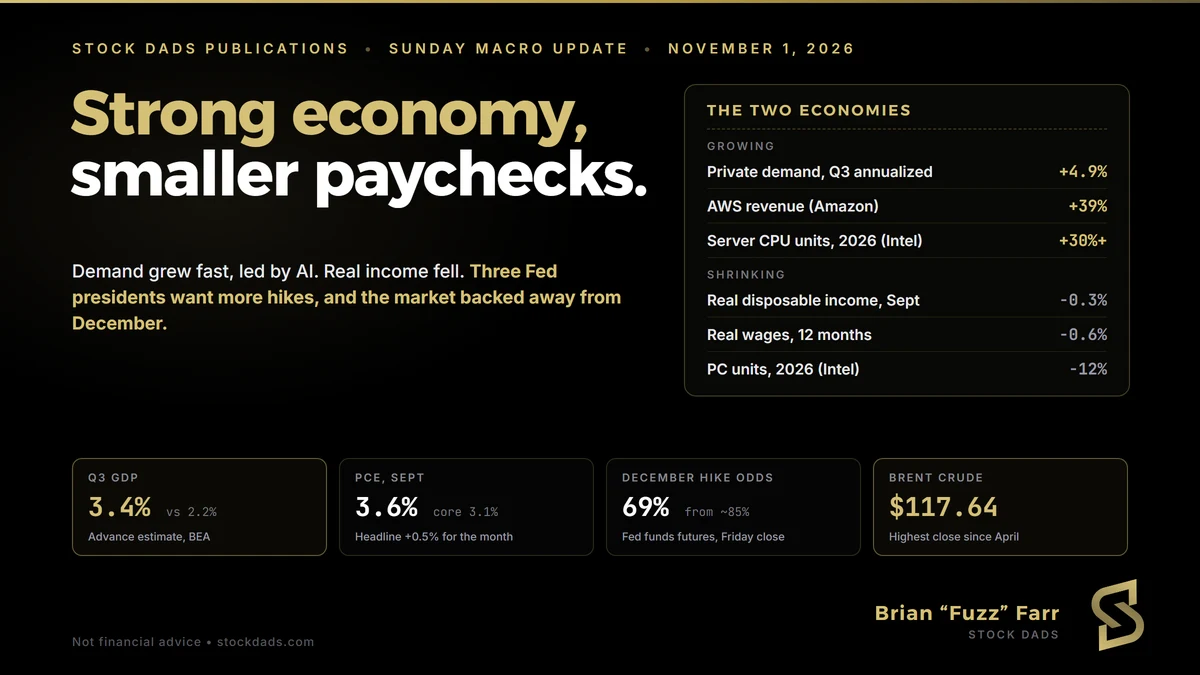
- The economy grew 3.4% last quarter. Private demand grew even faster, and computers for data centers led the way.
- Paychecks fell behind. After inflation, income fell 0.3% in September and spending didn’t grow at all. Wages are down 0.6% from a year ago in real terms.
- The Fed says more hikes are coming anyway. Three regional presidents said so on Friday. Their only disagreement is pace.
- The market judged the AI spenders. Alphabet fell 12.6% after raising its spending, Intel fell 28.6%, and memory stocks sold off on signs that price increases are slowing.
- Traders backed away from December. The odds of a hike fell to about 69% from about 85% right after the Fed, on the same day the presidents talked it up.
1. The economy is growing fast, and AI is a big part of it
The first estimate of Q3 GDP came in at 3.4% annualized, up from 2.2% in the second quarter.
The better number for demand is final sales to private domestic purchasers, which strips out inventories, trade and government. It grew 4.9%, up from 4.6%. That’s strong for any point in a cycle, and stronger for one with a 5% 10-year yield.
What led it tells the story:
- Business investment grew on equipment, led by information processing (mostly computers). That’s the AI buildout we’ve followed all earnings season, now showing up in GDP.
- Imports rose, led by capital goods. A lot of that equipment is built overseas, so part of the spending leaks out of U.S. growth.
- Consumer spending grew, but the leaders were health care and prescription drugs. That’s not a shopping spree.
Prices for the quarter looked calm: PCE inflation ran 2.1% annualized and core 2.5%, down from 5.0% and 3.3% in Q2. But the quarter averages hide the timing. Most of the cooling came early. September, the last month, ran hot.
2. Paychecks fell behind
The September income and spending report is out:
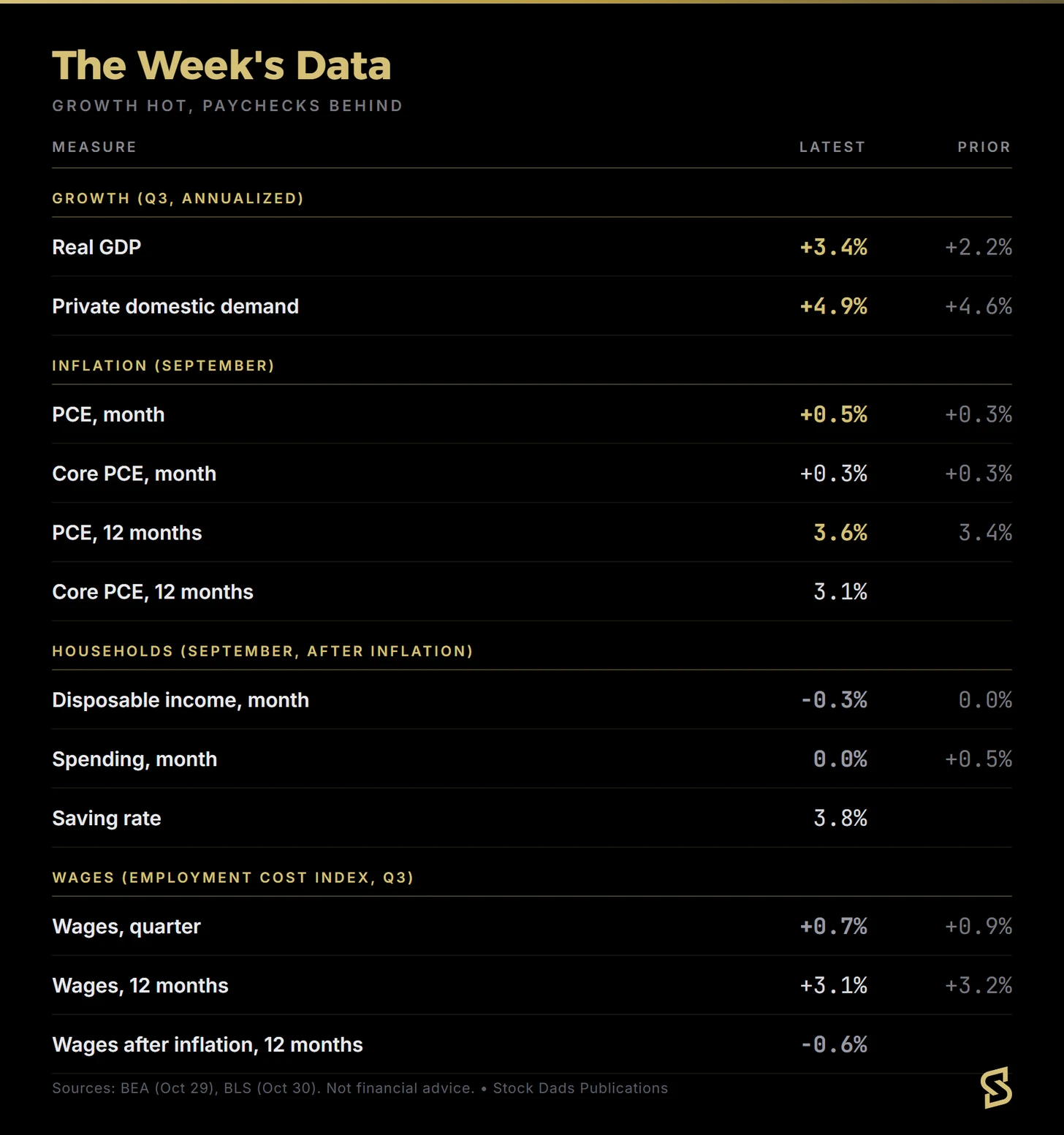
- Prices: headline PCE rose 0.5% for the month and 3.6% for the year. Core rose 0.3% and 3.1%.
- Income: after inflation, disposable income fell 0.3%.
- Spending: after inflation, it was flat. Nominal spending rose 0.5%, all of it from higher prices.
- Savings: the saving rate is 3.8%, so there isn’t much cushion left.
Friday’s Employment Cost Index filled in the wage side. Total compensation rose 0.8% in Q3, down from 0.9%. Wages alone rose 0.7%, down from 0.9%. Over the past year, wages are up 3.1%. With prices up 3.6%, that’s a 0.6% cut in real terms.
Wednesday’s post said tight skilled labor was the wage risk to watch. The ECI says it’s narrower than that. Compensation growth in construction and manufacturing slowed sharply in Q3 (0.5% and 0.4%, from 1.3% and 1.1%, not seasonally adjusted). The hot spots are specific: utilities up 5.1% over the year and aircraft manufacturing up 5.8%. Data centers and power are bidding up the people who build them. The rest of the labor market isn’t seeing the same raises.
The other side. Slower wage growth is good news on inflation. The thing the Fed fears most, a wage-price spiral, isn’t showing up. If wages keep cooling while energy prices settle, inflation can come down without the Fed doing much more. That’s Musalem’s second scenario, which we’ll get to.
This is the K from both directions. Last month’s earnings showed the top half spending: AmEx’s premium customers, Robinhood’s record margin loans, Visa’s highest spend band growing fastest. September’s data shows the bottom half. Prices rose faster than paychecks, and people stopped buying more stuff.
Intel added a piece I didn’t expect. Its CFO expects PC unit sales to fall about 12% this year and another 10% next year, because AI data centers are buying up the memory. He said plainly that he does not expect it to improve in 2027 (Intel call). Server chip units, meanwhile, are expected to grow more than 30% in both years. The data centers are outbidding consumers for the same parts.
3. The Fed says more hikes, at a slower pace
The Fed’s speaking blackout ended Friday, and three regional presidents said the same thing.
Lorie Logan (Dallas, voted to hold Wednesday) wants “at least two more 25-basis-point rate increases.” She described Wednesday’s hold as a question of pace, not direction: skipping a meeting “does not change the monetary policy destination.” On inflation being above target for nearly six years: “This is unacceptable.”
Alberto Musalem (St. Louis) said “additional firming of monetary policy will be necessary, and soon.” His reasoning: moving sooner in smaller steps beats “larger and abrupt actions taken later.”
Tom Barkin (Richmond) told SiriusXM the direction is “straightforward” and the question is pace (Reuters via WSAU). He also named AI investment as a source of demand-driven inflation, separate from supply shocks like energy (Stocktwits). That’s the first time I’ve seen a Fed official say it directly.
Add Wednesday’s two dissents for a hike, and five of the people setting policy have now said they want to go higher. Three of the five (Cook, Hammack and Logan) vote this year, and the direction of the room is clear.
Two parts of their speeches line up with what companies told us this month:
- AI credit. Musalem said credit spreads have widened “especially for those borrowers involved in the AI infrastructure build.” That’s the CoreWeave and Blue Owl story. He called it smaller than the tightening after Liberation Day and said he’s “not overly concerned.”
- Skilled trades. He said real wages are “increasing rapidly” for electricians and other trades working on data centers, while on average “many workers are falling behind in real terms.” The ECI said the same thing two days later.
The other side. Both Logan and Musalem read the jump in long-term yields as a sign of strength, not a drag. Logan said financial conditions are “currently providing a tailwind.” That’s different from Warsh’s “interest rates get in the cracks” on Wednesday, and different from my own emphasis. And Musalem laid out a real path where hikes aren’t needed: inflation recedes on its own if energy and shipping costs fall, productivity rises, or “spending on AI or data centers slows substantially.” The market spent the week testing that last one.
4. The market judged the AI spenders
The three biggest cloud companies all said the same thing: demand is bigger than supply, and they’ll spend more in 2027. The market reacted differently to each.
- Alphabet kept its 2026 capex at $195–205 billion and said 2027 will “increase significantly.” Free cash flow was negative for a second quarter, and it’s funding the gap with debt and stock. The stock fell 12.6% the next day.
- Amazon grew AWS 39%, its fastest in nearly five years, and posted its highest operating margin ever. It also spent $77.3 billion on property and equipment in one quarter, more than double a year ago. Trailing free cash flow is now negative $42.4 billion (release). Andy Jassy said 2027 capex will be “meaningfully more.” The stock fell 3.1% for the week.
- Microsoft pays for its spending out of its own cash flow. It finished the week down 0.5%.
The difference was cash. The company that funds AI from profits held. The ones borrowing or burning cash to do it got sold.
Then the supply chain cracked from both ends on Friday:
- The buyers. Intel fell 28.6% on its PC guidance, and AMD fell 10.9% with it.
- The sellers. Kioxia, one of the biggest flash memory makers, said NAND price increases slowed sharply and guided prices nearly flat for next quarter (Yahoo Finance). Sandisk fell 13.5% and Micron fell 5.3%.
That’s the first sign that memory pricing, one of the hottest upstream prices we tracked, may be peaking. Two weeks ago Western Digital and Seagate said they were sold out through 2028. Both can be true: storage is still short, and memory may be catching up. But it matters for the upstream inflation story, and I’ll weight it accordingly.
The charts are in Saturday’s post. The short version: QQQ fell 3.5% Friday on more than twice normal volume and finished the week down 2.0%, 9.1% below its October high. SMH closed at 522.49, three points above its 200-day average. SPY fell only 0.6% for the week.
The other side. Money left the AI trade, not the market. Here’s where it went, from Finviz:
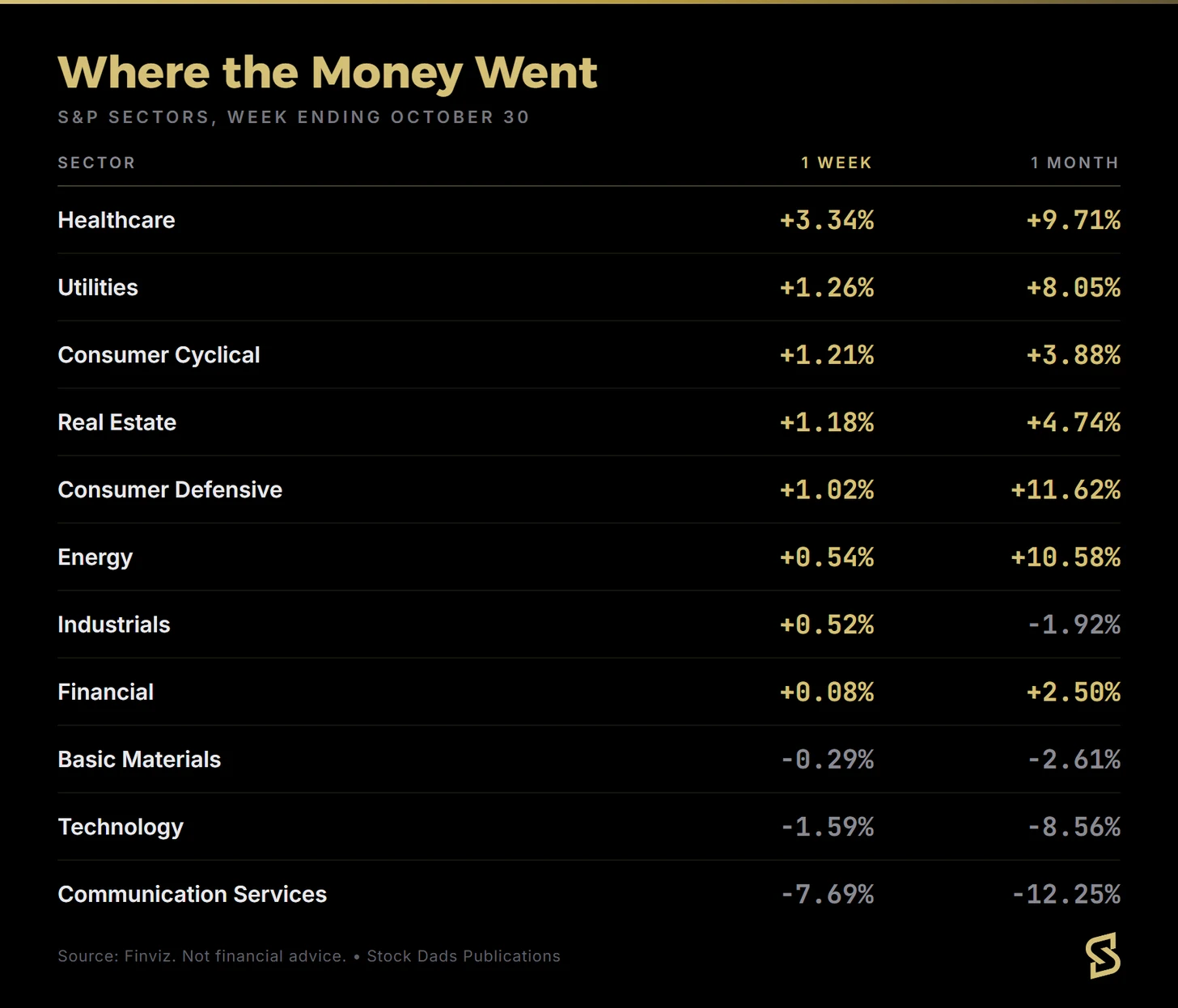
Eight of eleven sectors rose. Communication Services is Alphabet and Meta. Over the past month, staples, energy, healthcare and utilities are all up 8% or more, while tech and communication services are down 8% or more. IWM rose 1.3% for the week and staples (XLP) closed at a new high. And the demand numbers from the companies themselves didn't get worse: AWS sped up, Azure guided higher, and nobody cut 2027.
5. What the market did with it
December hike odds, from fed funds futures:
- About 85% right after the Fed on Wednesday
- 77.3% at Thursday’s close
- 69.4% at Friday’s close
The odds fell on the same day three presidents called for hikes. The 10-year yield fell to 4.93%, down from 5.05% on Wednesday and 5.31% at its October high. The VIX rose 13% on Friday to 19.42.
That’s the same split as last Sunday. The Fed is talking about inflation. The market is pricing the risk that the AI trade cracks and takes growth with it.
Oil didn’t get the memo. Brent closed Friday at $117.64, its highest close since April and above last week’s $116.72. WTI closed at $104.12. Gold fell 2.7% for the week.
6. Two cases
For more hikes:
- Private demand grew 4.9% last quarter, and AI investment is leading it.
- Headline inflation is 3.6% and September ran hot.
- Brent is at a six-month high.
- Five Fed officials have now said they want to go higher.
For fewer:
- Real income and real wages are falling. People stopped buying more in September.
- Wage growth is slowing, including in construction and manufacturing.
- Memory pricing may be peaking, and the market is punishing AI spenders that burn cash.
- A rate hike doesn’t lower the price of Brent or the cost of a data center electrician.
The market’s answer this week: still a hike in December, but less sure than Wednesday.
7. What’s next
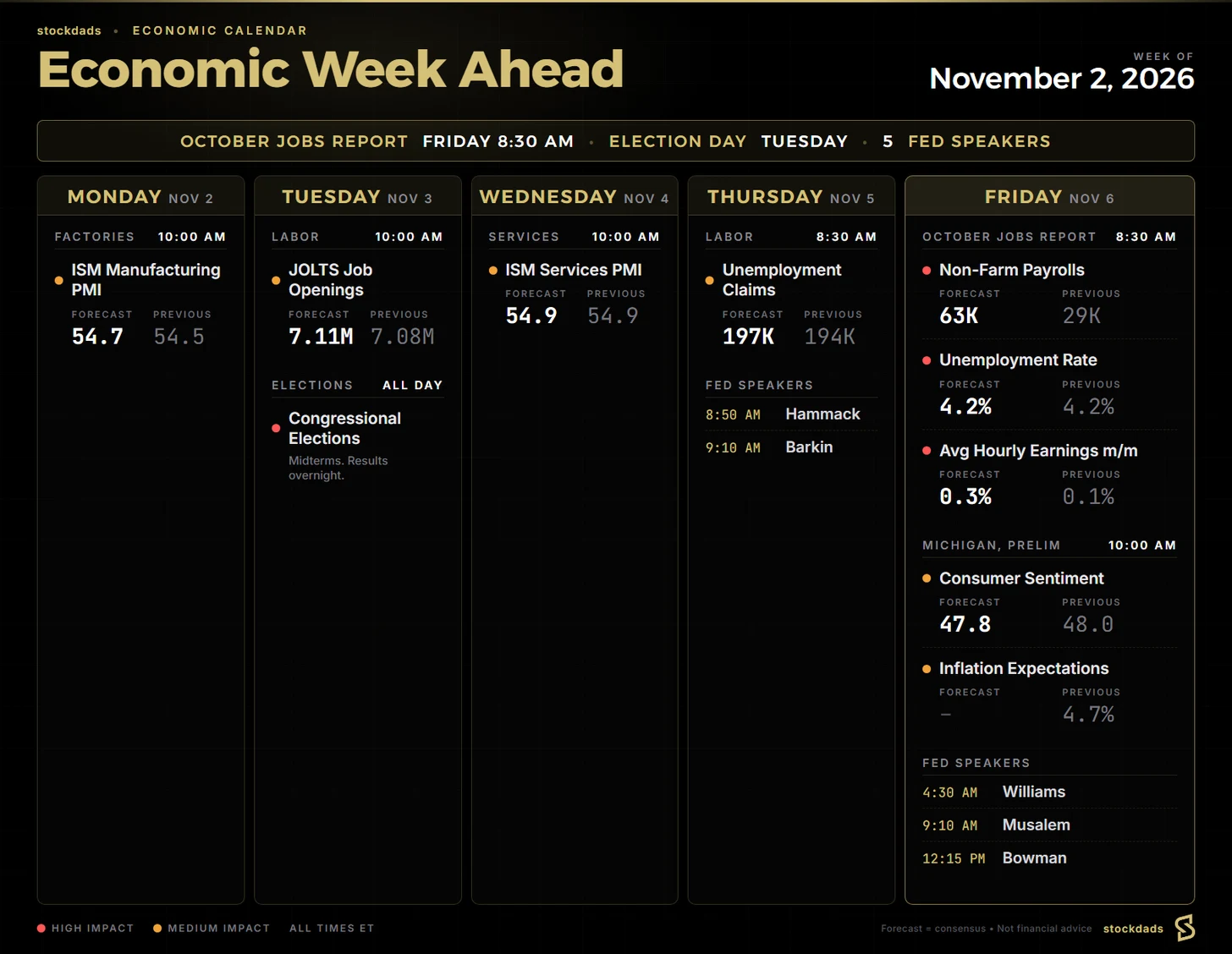
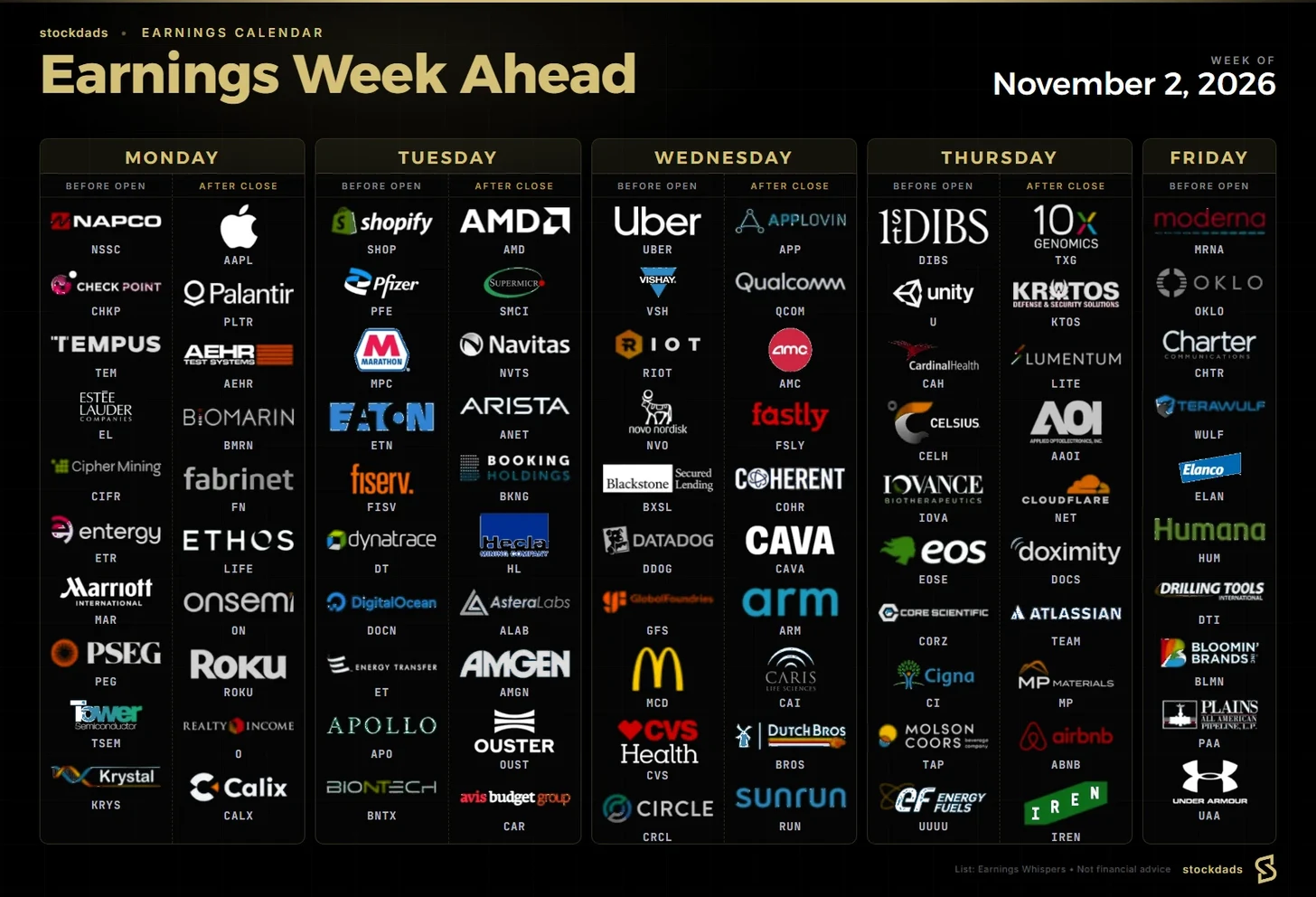
The day to circle is Friday. The October jobs report is expected to show 63,000 jobs after 29,000, with hourly earnings up 0.3% after 0.1%. After the ECI slowdown, a hot wage number would hand the hawks their best argument. Three Fed officials speak the same day: Williams, Musalem and Bowman.
On earnings, Apple reports Monday and AMD Tuesday. AMD is the next read on whether Intel’s PC warning spreads. Qualcomm and Arm on Wednesday give the phone side of the same memory question.
What would change my read (each named to a source):
- Average hourly earnings at 0.4% or more in Friday’s jobs report. The ECI slowdown would look like a one-quarter blip.
- ISM prices paid rising again in Monday’s manufacturing report (ISM). The upstream price story would be intact despite Kioxia.
- AMD guiding PC revenue down Tuesday. Intel’s memory warning would be an industry problem, not one company’s.
- SMH closing below 519.50, its 200-day average (levels from Saturday’s post). The chip selloff becomes a broader breakdown.
- December hike odds below 50% after Friday. The market would be calling the Fed’s bluff.
Checking Wednesday’s work
“The Fed held, but it’s leaning toward a hike.” Held up. Three presidents said so on Friday. The futures market leaned less, though.
“The companies that make things are raising prices.” Mostly held, with one crack. Kioxia’s guidance says memory price increases are slowing. Copper, steel, storage and freight haven’t changed.
“Jobs are steady but split.” The split is narrower than I said. The ECI shows wage growth slowing in construction and manufacturing. The trades shortage is concentrated around data centers and power.
“The consumer is still K-shaped.” Held, and the bottom of the K got worse. Real income fell and real spending stalled in September.
Wednesday’s triggers: none hit.
- Core PCE at 0.4% or more: no. It rose 0.3%, the same as August.
- Employment Cost Index speeding up: no. Compensation slowed to 0.8% from 0.9%, and wages to 0.7% from 0.9%.
- Amazon cutting its capex outlook: no. Jassy said 2027 will be “meaningfully more.”
Last Sunday’s distillate check: EIA showed a 1.5 million barrel draw, not a build. Next read comes Wednesday.
Brian Stock Dads
Published November 1, 2026. Nothing here is investment advice. I'm not a licensed financial advisor and this is market commentary, not a recommendation to buy or sell anything. GDP is BEA's advance estimate of October 29 and will be revised on November 25. Income, spending and PCE prices are from BEA's September release of October 29. Wage data is BLS's Employment Cost Index of October 30; industry figures are not seasonally adjusted. December hike odds are from FatTail's RateWatch, which applies CME FedWatch's method to fed funds futures, as of 5 p.m. ET October 30; CME's own FedWatch readings may differ slightly. Barkin's remarks are from wire coverage of a SiriusXM interview. Index, ETF, stock, yield, oil and gold levels are October 30 closes from Yahoo Finance. Kioxia's guidance is as reported by Yahoo Finance. Company figures and quotes are from earnings releases and calls. Do your own work and size your own risk.
Glossary
Final sales to private domestic purchasers. GDP minus inventories, trade and government. It measures what U.S. households and businesses are actually buying, and it’s the Fed’s favorite read on demand.
Real (inflation-adjusted). A number with price increases taken out. If your pay rises 3.1% and prices rise 3.6%, your real pay fell 0.5%.
Employment Cost Index (ECI). The government’s quarterly measure of what employers pay for workers, including wages and benefits. The Fed prefers it to hourly earnings because it isn’t skewed by which jobs are added or lost.
PCE. The Fed’s preferred inflation measure, from the Bureau of Economic Analysis. “Core” excludes food and energy.
Free cash flow. Cash from operations minus capex. Negative means the company is spending more than its business brings in.
NAND. The type of memory chip used in phones, laptops and data center storage drives.
Fed funds futures. Contracts that let traders bet on where the Fed’s rate will be. The hike odds in this post come from their prices.
Trade alongside our analysts
Join the 1%