Macro update
Nvidia Earnings Preview After Jensen Huang’s Exit
Brian "Fuzz" Farr · · 12 min read
The short version
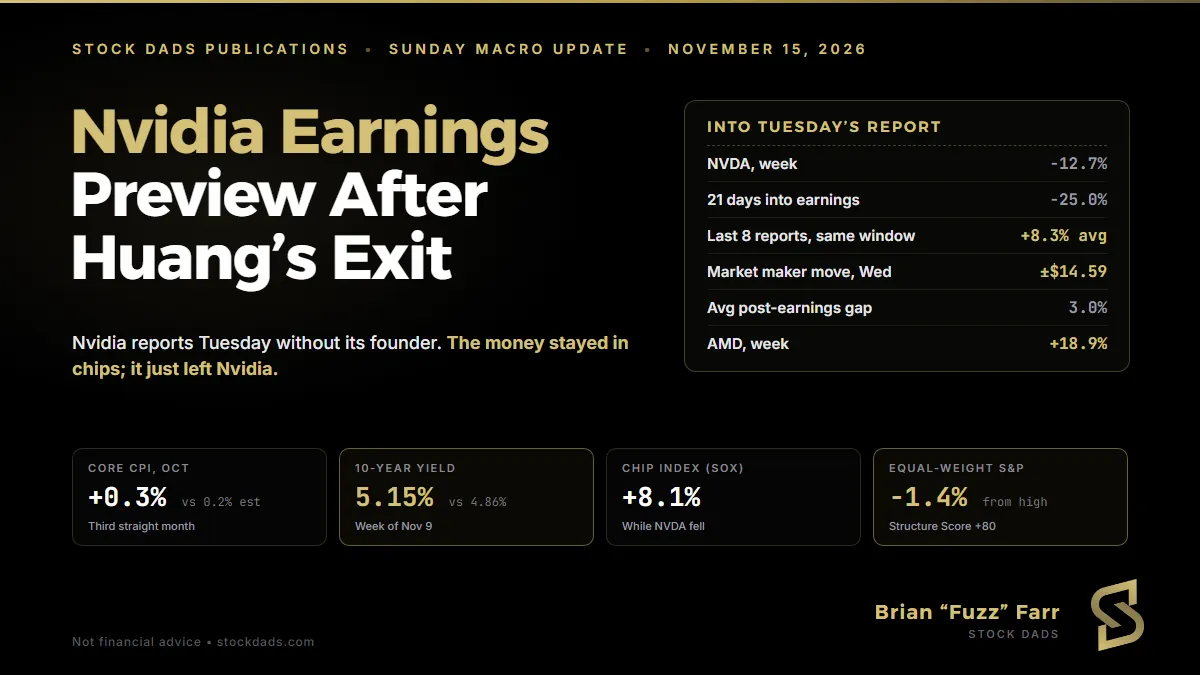
- Nvidia reports Tuesday without its founder. Jensen Huang resigned Thursday during a board investigation, and two large shareholders now want the search for his replacement slowed down so he can come back. The stock fell 12.7% for the week.
- Investors didn’t leave the AI trade. They changed horses. The chip index rose 8% while Nvidia fell, and AMD gained 19%. CoreWeave rose 25% in a day after raising its outlook.
- The options market expects a big move. Market makers are pricing about 9% either way by Wednesday, roughly three times Nvidia’s average post-earnings gap over the last eight reports.
- Rates were the bigger macro story. Core inflation rose 0.3% for a third month, a Fed governor floated a half-point hike, and the 10-year yield jumped to 5.15%.
- The average stock is fine. The equal-weight S&P 500 is 1.4% from its high with a strong trend reading. The damage sits in the semiconductors and in Nvidia most of all.
1. Nvidia without Huang
On Thursday, Nvidia announced that Jensen Huang had resigned as president, CEO and director, effective immediately (8-K). The filing gave no reason. CFO Colette Kress is interim CEO while keeping the CFO job, and the board named its first-ever chair, Harvey Jones, who said operations, customer commitments and the product roadmap continue “without interruption.”
The reporting since then has two threads. One is personal: news outlets report extramarital relationships, including one with a woman suspected of spying for China (Washington Post). The other matters more for the stock. She reportedly worked with Megaspeed, a Singapore company and Nvidia customer that the Justice Department is investigating for diverting restricted Nvidia chips to China. According to the New York Times, the original Commerce probe moved to Justice in 2025 after Nvidia’s lawyer contacted a senior Commerce official (CNBC). Commerce Secretary Lutnick testifies before the Senate Banking Committee on December 10 about whether Commerce is keeping advanced AI chips out of China, and Huang has been asked to testify too. None of the allegations have been proven, and the board’s own investigation is still open.
Then the pushback started. On Friday, Altimeter’s Brad Gerstner and Atreides’ Gavin Baker, who together held about $2.1 billion of Nvidia stock at the end of June, published a letter asking the board for a “slow, measured, and deliberate process” that keeps Huang’s return possible. They didn’t ask for him back right away, and they said Kress can lead the company “capably” in the meantime. Elon Musk signed a petition to reinstate him and said Saturday that without Huang “critical deals will be lost.”
For the next few weeks, I’d keep two things separate. The board has a governance problem and a national-security problem at the same time, and they pull in different directions. Big shareholders want the founder kept on the table. Washington wants to know how restricted chips got to China. Trump meets Xi in Shenzhen on Wednesday and Thursday, and officials say he doesn’t plan to raise the Nvidia affair. Congress is pushing for tighter chip controls anyway (Korea Times/SCMP).
2. The money stayed in chips
The stock had started falling before the resignation. Nvidia closed at $186.64 on November 6, slid after the Times story on Monday, and finished Friday at $162.85. Its intraday low on Thursday was $148.80.
The rest of the semiconductor group went the other way. The PHLX semiconductor index rose 8.1% for the week. AMD rose 18.9%, Broadcom 18.2% and Micron 12.8%, all Yahoo Finance closes. Benzinga noted the Nvidia-to-AMD price ratio hit its lowest since March 2023 (Benzinga). AMD and Broadcom gave back 8.8% and 4.8% on Friday, so the swap wasn’t one-way, but the week’s message was clear: investors still want AI chips and are less sure about this particular one.
The reports from Nvidia’s customers and suppliers back that up. CoreWeave raised its full-year revenue outlook and didn’t cut spending, and the stock rose 24.7% on Wednesday (Motley Fool). Its CFO said it won’t sell more unsecured parent-company bonds through 2027 at today’s yields, a direct answer to the bond market’s worries. Applied Materials posted record revenue and guided above estimates (release).
Two reports were weaker. Nebius beat on revenue but said 2026 revenue will land at the low end of its range, guided 2027 capex to $40-45 billion, and pointed to delays at third-party data center sites. The stock fell 16.8% (TipRanks). Cisco raised its AI target for the year to $9 billion, but product orders slowed to 21% growth from 35%, and its CEO called AI orders “lumpy” (24/7 Wall St.). Both fit what we’ve heard for a month. Demand is strong, and the physical build, from sites to power to delivery dates, is the limit.
3. What Tuesday has to show
Nvidia reports after the close Tuesday, with the call at 5 p.m. ET. Analysts expect about $109 billion in revenue and adjusted EPS of roughly $2.47 to $2.49. Nvidia’s own guidance was about $108 billion, plus or minus 2% (Invezz, Motley Fool).
The numbers will probably be fine. Nvidia beat estimates in seven of its last eight reports, and nothing in this week’s supplier reports points to a demand problem. The call is where the risk is. Kress has to give guidance as interim CEO and CFO, with no permanent leader and an open investigation. I’d listen for four things: whether next quarter’s guide holds up, anything on China and export licenses, whether customers have paused or changed commitments since Thursday, and the timing of the next chip generation, Rubin.
My earnings study in thinkorswim tracks the stock around its last eight reports:
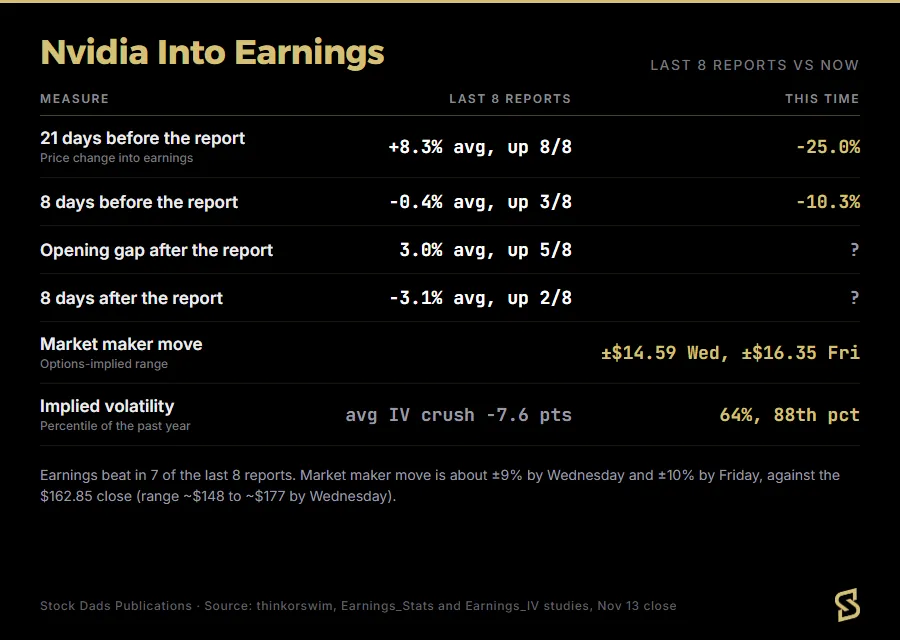
Two things stand out. In all eight of the last reports, Nvidia rose in the 21 trading days before earnings, by an average of 8.3%. This time it’s down 25.0%, the first decline into a report in the eight my study covers. And after the report, the stock has tended to fade: over the following eight days it rose only twice, with an average move of -3.1%.
The options market is bracing for something bigger than usual. Implied volatility is 64% and in the 88th percentile of its past year. The market maker move, the expected range priced into options, is about $14.59 either way by Wednesday’s expiration and $16.35 by Friday’s. That’s about 9% and 10% of Friday’s close, or a range of roughly $148 to $177 by Wednesday. Nvidia’s average opening gap after its last eight reports was only 3.0%.
None of that tells us direction. It tells us the market expects the governance story to come through in the price, one way or the other. The history also has a quieter lesson. Big run-ups into earnings were followed by fades. This time the stock arrives after a 25% drop, so a lot of bad news may already be priced.
4. The Nvidia chart
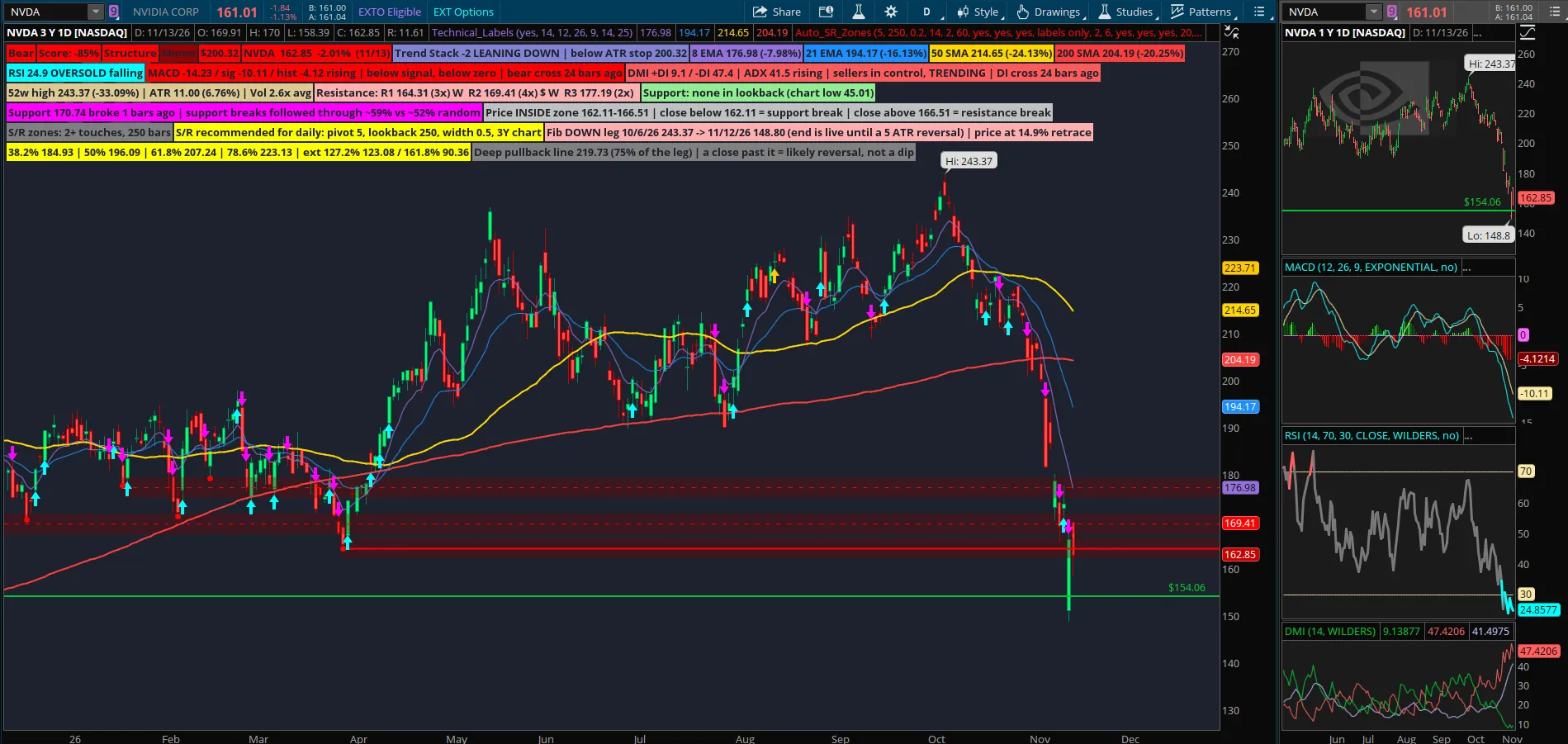
The chart is about as stretched as it gets. Nvidia is 20% below its 200-day moving average ($204.19) and below every shorter average, with the 50-day at $214.65 and the 21-day EMA at $194.17. My Structure Score, which checks how five moving averages are stacked and whether price is above a volatility-based trailing stop (it runs from -100 to +100), reads -85.
The momentum reads agree. RSI, which compares recent gains to recent losses on a 0-100 scale, is 24.9, deeply oversold. ADX, which measures trend strength, is 41.5 and rising, with sellers well in control on DMI. MACD is below its signal line and below zero. Oversold readings in a strong downtrend can stay oversold for a while, so on its own the RSI doesn’t call a bottom.
The levels are close together. Price is sitting inside a zone from $162.11 to $166.51. A close above $166.51 would be the first resistance break, with tested resistance at $169.41 (four touches) and $177.19. Below, my support tool finds no tested level in the last year, and the nearest marker is Thursday’s low of $148.80. That lines up almost exactly with the bottom of the options-implied range.
5. Rates moved more than stocks did
October’s consumer prices rose 0.4%, and core prices, which strip out food and energy, rose 0.3% for the third month in a row (BLS). Forecasts were 0.3% and 0.2%. Electricity rose 0.9%, hospital services 0.8% and car insurance 0.7%. There’s an odd gap in this report: BLS couldn’t publish most year-over-year numbers, because last year’s government shutdown meant October 2025 prices were never collected.
The timing made it worse. Hours before the release, Fed Governor Christopher Waller said in London that he still supported a quarter-point hike in December, but that if core inflation came in “around 0.3 percent or even higher,” then “a 50 basis point hike in the policy rate should be considered.” He added that “hiking only 25 basis points would put our credibility at risk” (Federal Reserve). Core came in at 0.3%. Waller also said he’s watching whether prices for high-tech goods tied to the AI buildout keep rising at “the very high rate of recent months.” That’s the memory-cost story from the earnings calls, now in a Fed governor’s speech.
Bonds took it hard. The 10-year yield rose from 4.86% to 5.15% for the week, and Tuesday’s jump was the biggest in 19 months (CNN). December hike odds rose to roughly 90% for a quarter point, with the rest on a half point (Yahoo/Investing.com). The dollar rose and gold fell 4.6%.
Producer prices on Friday didn’t help. The headline rose 0.3%, a touch under forecast, but it’s up 6.5% from a year ago, the most since November 2022. The core measure that excludes food, energy and trade rose 0.5% for a second month and 4.9% for the year (BLS). Truck freight rose 3.9%, more than 80% of the services increase.
The other side deserves a fair hearing. Oil kept easing, with Brent down 2.5% to $95.84, and gasoline prices fell before seasonal adjustment. Used car prices dropped 1.2%. Core has been steady at 0.3%, not speeding up. The productivity numbers from last week still argue that strong wage gains aren’t feeding prices one for one. A hike looks priced in. A half-point hike is not, and that’s the risk to watch.
6. The market underneath
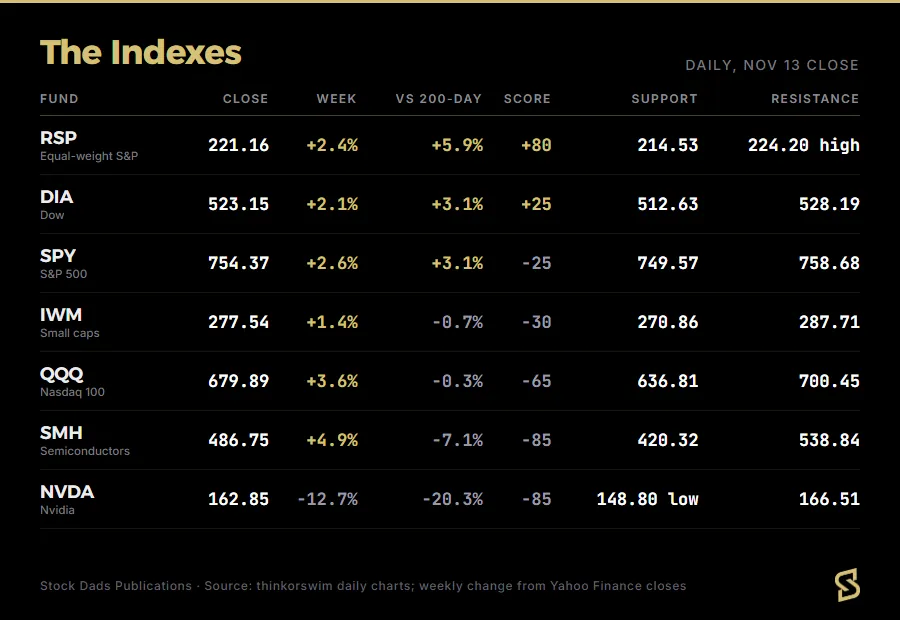
SPY gained 2.6% for the week and closed at 754.37, back above its 200-day average (731.92) by about 3%. Its Structure Score is still -25, though, because price sits below the 50-day (764.43) and the trailing stop (775.45). It’s trading inside a zone from 753.58 to 758.68. A close above 758.68 clears it, and a close below 753.58 puts support at 749.57 and then the 200-day back in play.
QQQ is the chart on the edge. It closed back above its 200-day on Wednesday and Thursday, then slipped to 679.89 on Friday, 0.3% below it (682.24). Its Structure Score is -65 and ADX is 30 but falling, which says the selling trend is losing force without having reversed. It has retraced 28% of its October-November drop. Resistance is 700.45, and support is a long way down at 636.81.
SMH gained 4.9% but is still 7.1% below its 200-day (523.89), with a Score of -85 and sellers in control. The 200-day sits right at the 38.2% retracement of its drop (519.65), which makes 520-524 the line to watch.
The best chart on the board is RSP, the equal-weight S&P 500. Its Structure Score is +80 with all moving averages stacked up, it’s 5.9% above its 200-day, and it closed 1.4% below the high it set on November 5. DIA also has a full uptrend stack. IWM is the laggard, 0.7% below its 200-day with a Score of -30 and support at 270.86, a level it has held four times.
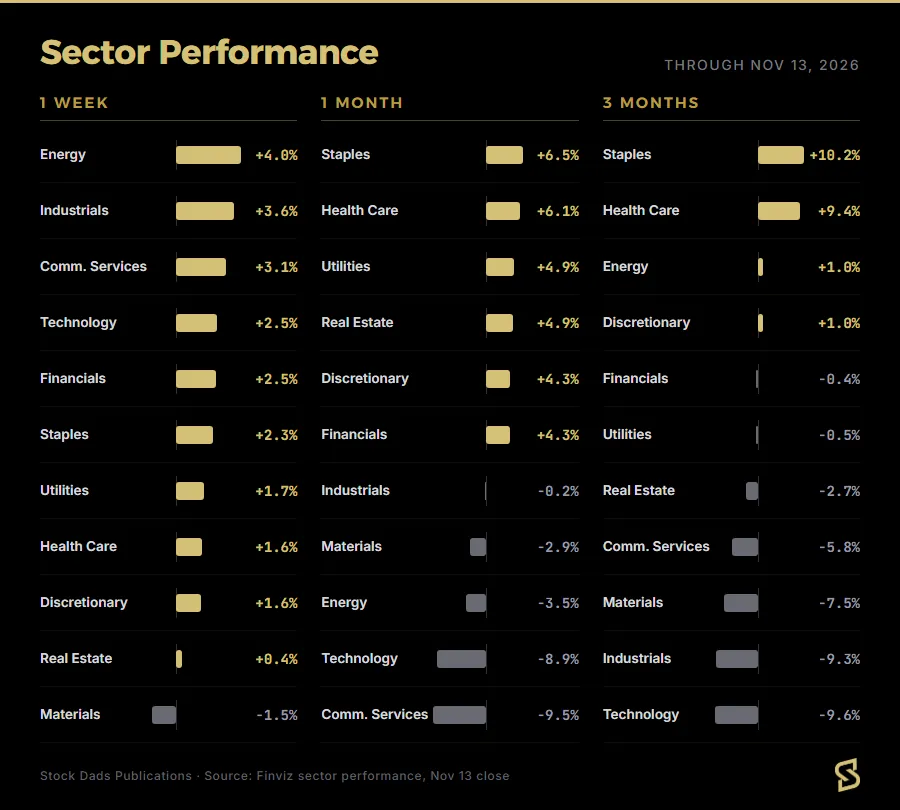
The sectors tell the same story over a longer window. Last week was a broad bounce: ten of eleven sectors rose, led by energy (+4.0%) and industrials (+3.6%), with basic materials the only loser (-1.5%). Energy led even though oil fell 2.5%, which looks more like a rebound after its 12% drop the week before than a new trend. Step back a month and the leadership flips to defense. Consumer staples (+6.5%) and health care (+6.1%) are on top, while technology (-8.9%) and communication services (-9.5%) are at the bottom. Over three months the gap is wider still, with staples up 10.2% and technology down 9.6%. A one-week bounce in tech hasn’t changed who’s been leading.
Put together, it’s the same picture as two weeks ago, a little better. The typical stock is in an uptrend. The index weakness comes from the biggest chip names, and Nvidia is the biggest of all.
7. What’s next
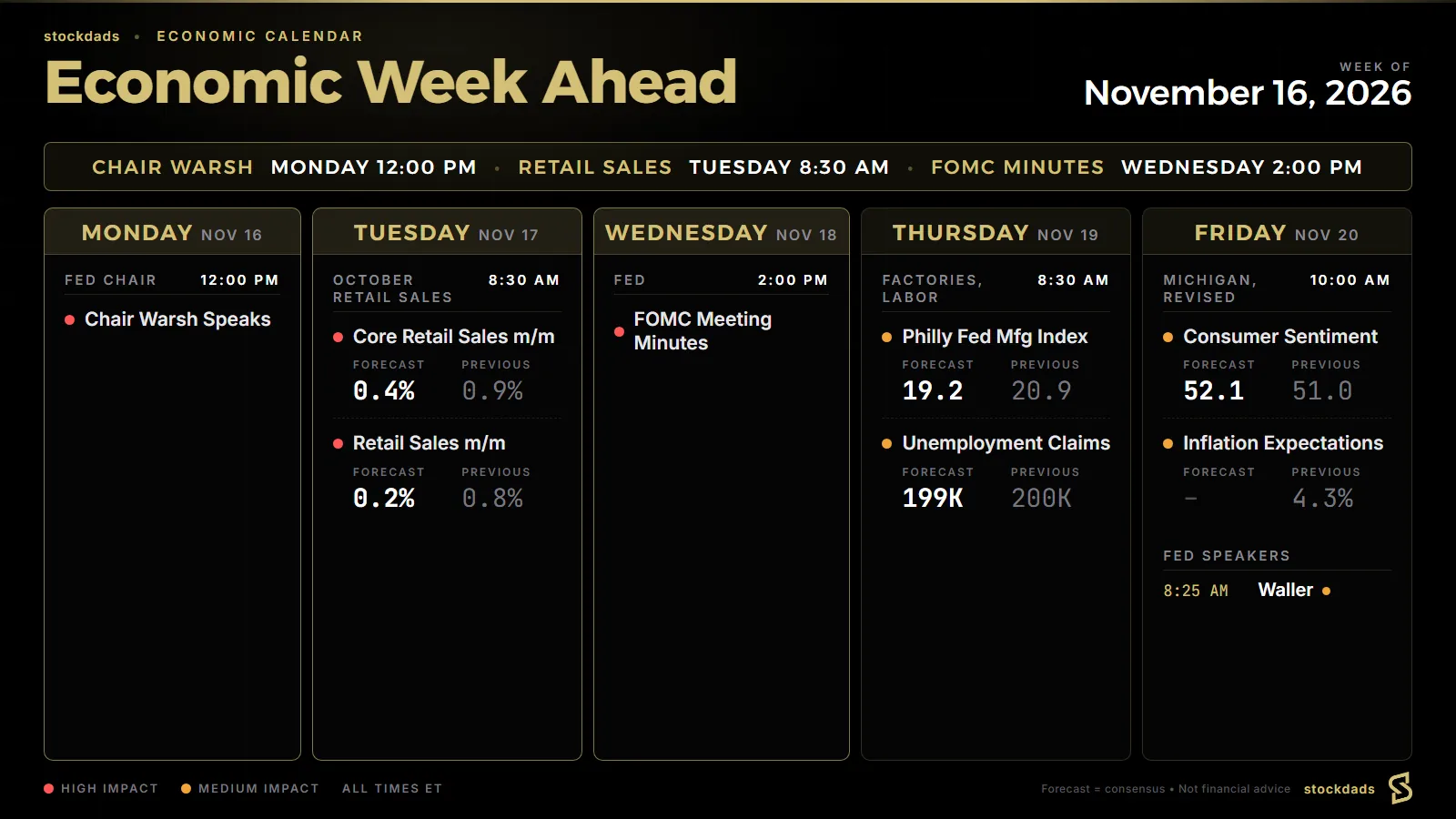
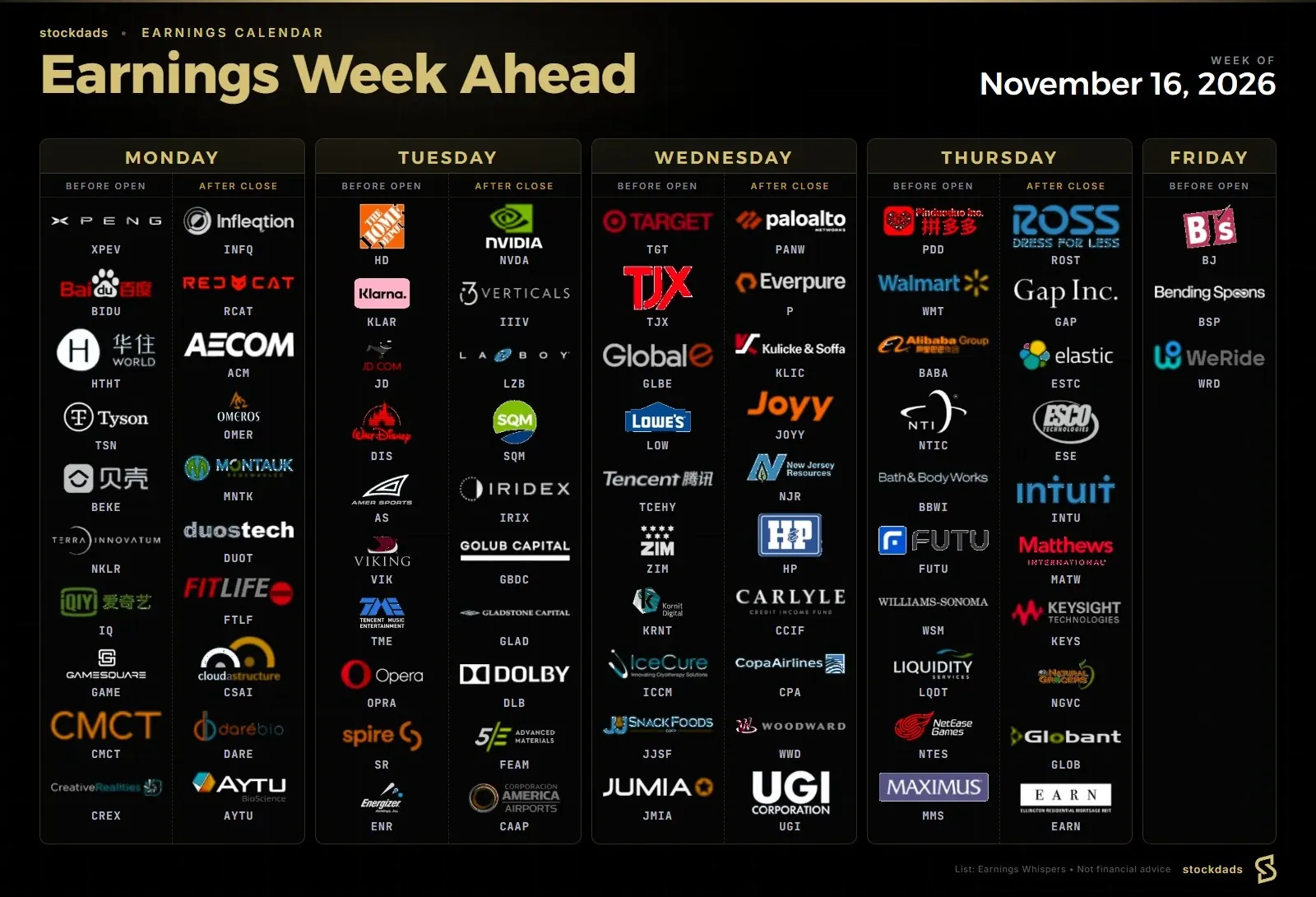
The week has two stories, and they meet on Tuesday.
The first is Nvidia, after the close Tuesday. The second is the consumer. October retail sales come out Tuesday morning, with core sales expected up 0.4% after 0.9% (Forex Factory). Then Home Depot reports Tuesday, Lowe’s, Target and TJX on Wednesday, Walmart on Thursday morning, and Ross and Gap Thursday night. After a month of bottom-of-the-K signals from Affirm, Charter and the restaurant chains, this is the big-box check.
The Fed is busy too. Chair Warsh speaks Monday at noon, the minutes from the October meeting come out Wednesday at 2 p.m., and Waller speaks again Friday morning. Jobless claims Thursday are expected at 199,000 after 200,000. Trump and Xi meet in Shenzhen on Wednesday and Thursday.
What would change my read:
- Nvidia cuts next quarter’s guidance or says customers paused orders. That would turn a governance story into a demand story, and the rotation into AMD and Broadcom wouldn’t protect the chip group.
- Core retail sales below zero on Tuesday. With core prices up 0.3% a month, a drop in nominal spending would mean real spending is shrinking going into the holidays.
- The 10-year closes above 5.25%. That would say the bond market is pricing more than one hike, and it would pressure the high-valuation names hardest.
If two of those happen, I’ll say so on Wednesday.
Checking last week’s work
Last Sunday said Thursday’s crash looked more like forced selling than a verdict on AI. That held up. The VIX closed under 20 on Monday and stayed there, and the S&P 500 recovered most of the drop, from 7,376.86 to 7,561.67 (the pre-crash close was 7,688.62).
Last Sunday’s triggers:
- Core CPI at 0.4% or more: no. It came in at 0.3%, above the 0.2% forecast and exactly Waller’s threshold for a bigger hike.
- CoreWeave cutting capex or pushing out revenue: no, the opposite. It raised its outlook and the low end of its spending range.
- VIX closing below 20 by Friday: yes. It closed at 19.92 Monday, 17.49 Wednesday and 19.30 Friday.
One of three hit. It’s the one that says the mechanical selling is done, so I’ll stand by last week’s read. The financing worry also eased: CoreWeave’s results answered it for now, though Nebius’s guidance shows the delivery problems aren’t over.
The November 7 levels: SPY held above its 200-day (730.38) and RSP stayed above its trailing stop (215.89), so neither breakdown trigger hit. QQQ did close back above its 200-day on Wednesday and Thursday, which I said would make the crash look like a one-day flush. It gave that back on Friday, so I’d call it unresolved.
Brian Stock Dads
Published November 15, 2026. Nothing here is investment advice. I'm not a licensed financial advisor and this is market commentary, not a recommendation to buy or sell anything. Nvidia's resignation details are from its November 12 8-K; the reasons for the resignation are as reported by news outlets and are allegations, not findings. Chart readings are from thinkorswim daily charts as of the November 13 close. The earnings history and implied-move estimate are from my Earnings_Stats and Earnings_IV studies over Nvidia's last eight reports; the market maker move is from thinkorswim for the November 18 and November 20 expirations. Analyst estimates are from the previews linked and vary by source. CPI is BLS's October release of November 10; PPI is BLS's October release of November 13. December hike odds are CME FedWatch as reported by Investing.com and vary by time of day. Consensus forecasts for next week are from Forex Factory. Index, ETF, stock, yield, oil and gold levels are November 13 closes from Yahoo Finance. Sector performance is from Finviz as of November 13. Do your own work and size your own risk.
Trade alongside our analysts
Join the 1%