Macro update
AI Stock Selloff
Brian "Fuzz" Farr · · 13 min read
If you missed it, Saturday’s Earnings Week Technicals covers the charts and the levels, including QQQ losing its 200-day average. This post is the macro side.
The short and sweet version
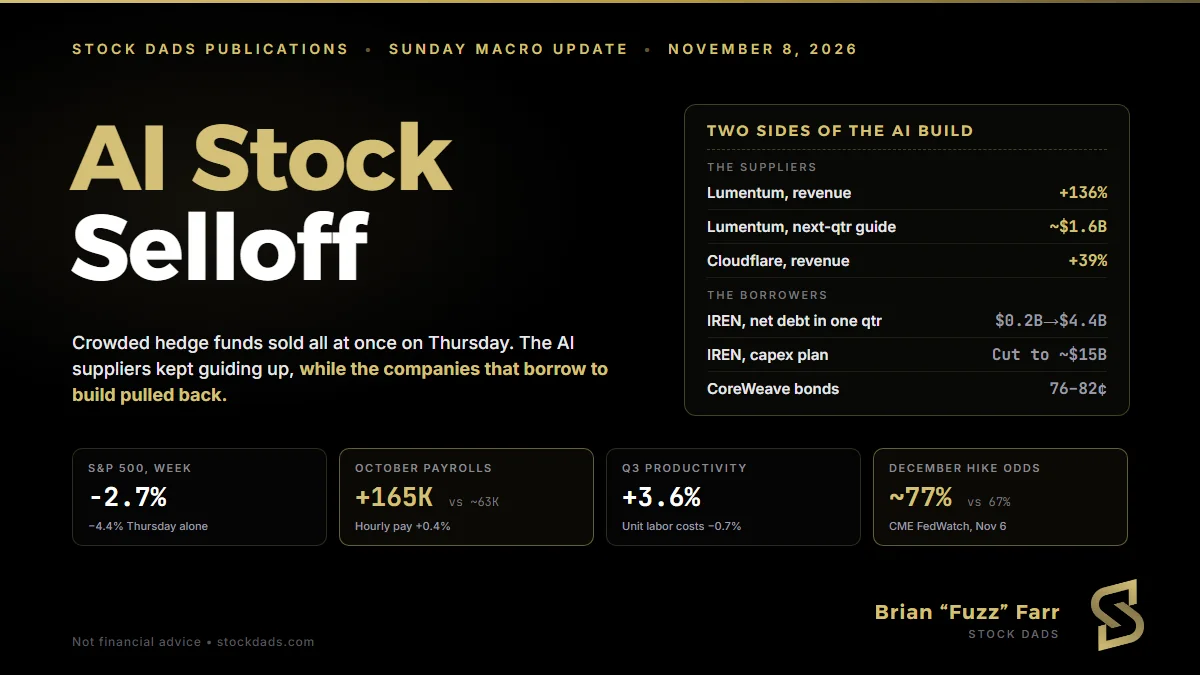
- Thursday was a forced sale more than a verdict on AI. Crowded hedge funds cut risk all at once, and volatility-targeting funds added an estimated $135 billion of selling. The S&P 500 fell 4.4% that day and 2.7% for the week.
- The companies selling into the AI build had a good week. Lumentum guided another $350 million of quarterly revenue on top, and Cloudflare grew 39%. The weak spot is the borrowers. IREN cut its spending plan “purely and simply” because of financial markets, and CoreWeave’s bonds trade around 80 cents.
- Texas is the policy risk that matters, and it’s already here. The new governor-elect wants a data center moratorium, but she isn’t in office until January. Meanwhile, the current governor’s audit has a new load approved and waiting, and Vistra says it’s lowering Texas power prices.
- Jobs beat by a mile, and productivity softened the blow. Payrolls rose 165,000 and hourly pay rose 0.4%. But output per hour grew 3.6% and unit labor costs fell, so the wage gain is less inflationary than it looks. December hike odds are about 77%.
- The consumer split wider. Airbnb and Lyft set records. Affirm’s hardship modifications doubled, and Charter says lower-income households are signing up for internet less.
1. What happened Thursday
The S&P 500 fell 4.4% on Thursday, its worst day since April 2025, and the tech sector fell 7.3%, its worst since March 2020. The Philadelphia semiconductor index lost 12.25%. Friday’s bounce was small, and the S&P finished the week down 2.7%, its worst week since June. SMH, the chip fund, ended down 11.2%.
The headlines blamed the election, and the election was the spark. But the way stocks fell points at who was selling. Goldman’s prime brokerage desk, which lends to hedge funds, estimated tech-focused long-short funds lost more than 4% on Thursday alone. They had been up 24% for the year in June and are now roughly flat (Reuters via Investing.com). Goldman’s John Flood said funds had cut risk heavily before the midterms, chased Wednesday’s rally, and were caught “wrong-footed” the next morning.
Two things made it worse. The funds all owned the same stocks. Tech was about 23.5% of hedge fund exposure on Goldman’s books, near a five-year high, with gross leverage around 310% (The Private Banker, citing Bloomberg). When one platform cuts, the others feel it in the same names. Then the machines joined in. Barclays estimated that volatility-control funds, which sell automatically when markets get choppier, would unload about $135 billion of stock futures over one to two days, the biggest cut since December 2018.
Nomura’s Charlie McElligott called it “shooting the generals”: funds dumping the year’s biggest winners to protect their 2026 returns before year-end (Yahoo Finance). The fund-level damage shows it. Lone Pine was up about 40% in the first half and is now down 7.5% for the year (WSJ via Seeking Alpha). Walleye let go its head of equities and is returning capital. JPMorgan says hedge funds overall lost 3% in October, their worst month since the pandemic.
One correction to a list that’s been going around. Arini, the fund with the worst number on it (down 32% this year, per Bloomberg), is a credit fund that lost money on European junk bonds, not AI stocks (Hedgeweek). Several of the other sizes on that list are firm-wide totals, not the fund that lost money.
Forced selling explains how violent Thursday was. It doesn’t tell us where prices settle, and that’s the next section.
2. Demand held, financing didn’t
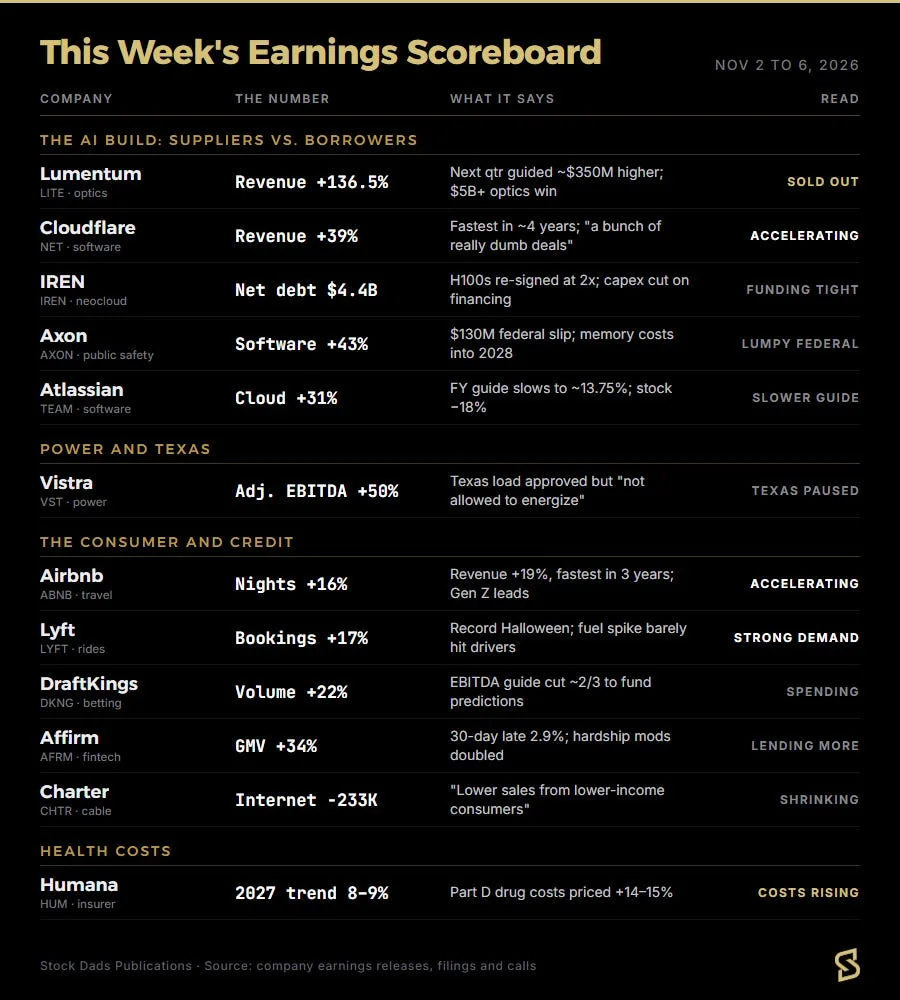
The companies that sell into AI data centers reported strong numbers again. Lumentum, which makes the lasers that move data between AI chips, more than doubled revenue to $1.26 billion and guided next quarter to about $1.6 billion. Its CEO noted the $350 million step-up alone is more than the whole company’s quarterly revenue two years ago, and it landed a second co-packaged optics deal “backed by purchase commitments exceeding $5 billion” (Lumentum release, November 2). Cloudflare grew 39%, its fastest in nearly four years, and added a record 158,000 paying customers (Cloudflare release). Axon’s AI products passed $100 million in annual recurring revenue.
The trouble is with the companies that borrow to build. IREN owns data centers and rents GPUs to Microsoft and AI labs, and its demand numbers were the best I’ve seen from a neocloud. It re-signed old Nvidia H100 chips at double their original price for multiple years. Then it cut its spending plan to about $15 billion. Co-CEO Daniel Roberts: “It is purely and simply financial markets and the current state.” He added that “capital markets have become more selective in the last few weeks, and the questions have undoubtedly moved from how big the contract is to whether it can be delivered, financed, and run at a profit” (IREN call). Its net debt went from $216 million to $4.4 billion in one quarter.
Cloudflare’s CEO, Matthew Prince, was blunter about the industry: “We have watched a bunch of really dumb deals get done. Obviously, the market is digesting those right now” (Cloudflare call). The bond market agrees with him. CoreWeave’s unsecured bonds trade between 76 and 82 cents on the dollar, yielding more than 16%, and on Thursday 23 of 24 high-yield data center bonds in Morgan Stanley’s group widened (Bloomberg via Yahoo). The spreads line up by tenant, with CoreWeave-linked paper widest and Amazon and Meta paper tightest. Those are thinly traded bonds, so I’d lean on the direction and the ranking more than any single price.
I don’t want to make this sound worse than it is. IREN’s customers are prepaying up to 90% of GPU costs on new contracts, which means the buyers are funding part of the build themselves. Affirm priced a bond deal on Thursday that was four times oversubscribed, so credit markets are open for borrowers with a track record. And memory, the other cost pressure, keeps spreading. Axon said memory costs will be a margin headwind through 2028 and split its new body camera into two models partly because of them (Axon call).
CoreWeave reports Tuesday night. It’s the cleanest test of whether the money side is tightening further.
3. Texas is the policy lever
Wednesday’s post framed the election risk around Congress, and the AP’s calls make that majority bigger than it looked Wednesday: Democrats hold 54 Senate seats to 44 and 254 House seats to 162. Still, the governor’s races matter more for data centers, and Texas most of all. Gina Hinojosa beat Greg Abbott and has promised to call for a data center moratorium lasting until the Legislature meets in January (KSAT). The AP has also called Ohio for Amy Acton, and Keisha Lance Bottoms won Georgia. Both are Democrats who backed slowing data center construction (Bloomberg via Yahoo).
Timing matters here. Nobody new takes office until January, and Texas inaugurations are usually the third Tuesday of the month. Until then Abbott is governor, and the slowdown in Texas is his. His August grid audit is still running, and Vistra’s CEO, Jim Burke, described what it’s doing on the ground: “We know there is load that’s approved to energize, but it has not been allowed to energize.” He said Texas power prices have been “trending lower” partly because of “the data center audit and permitting pause,” and that “the pacing was already being impacted ahead of the election” (Vistra call).
Burke doesn’t expect a moratorium. He called it “a bridge too far” and said Hinojosa’s message so far is “very similar” to Abbott’s, growth with guardrails. He expects the permit hold to lift around mid-December, when the audit wraps up. The market took the other side on Wednesday, when Vistra fell 14% to a 52-week low, and Vistra itself posted record profit, up 50%, two days later. Abbott’s audit shows up in IREN’s risk factors too, though its biggest Texas campus is already connected to the grid.
My read is that the governors matter more than Congress for this trade, and that the Texas slowdown is already in place rather than waiting on January. I could be wrong about the size of it. A split Texas legislature makes a statewide ban hard to pass, and the companies with power already connected may end up with pricing power.
4. Jobs beat, and productivity softened it
The October jobs report showed 165,000 new jobs, against about 63,000 expected. August and September were revised up by 84,000 combined, unemployment fell to 4.1%, and average hourly earnings rose 0.4% for the month. That 0.4% was one of Wednesday’s triggers. Jobless claims fell to 189,000, matching the lowest level since 1969 (Reuters via Yahoo).
The softer parts are worth a look. People working part-time because they can’t find full-time work rose by 339,000 to 4.8 million. And pay is still behind prices: hourly earnings are up 3.1% from a year ago, against 3.7% for the September CPI.
The number that changes how to read the jobs report came out a day earlier. Third-quarter productivity rose 3.6% annualized. Output grew 3.7% while hours worked grew 0.1%, and unit labor costs, the labor cost of making one unit of output, fell 0.7%. When output per hour grows that fast, a company can pay more without raising prices. That’s the case for wage growth not feeding inflation, and it fits what companies told us this week. Airbnb’s AI now handles 40% of support issues and its headcount is still growing. Cloudflare cut the people who compile reports and is “hiring like crazy” for other roles. DraftKings built a new business “with mostly the same headcount.” Airbnb’s CEO also said entry-level jobs “are harder to come by because AI can do them” (Airbnb call), which may help explain the rise in involuntary part-time work.
The Fed is still leaning toward a hike. December odds rose to about 77% on Friday from about 67% a week earlier (24/7 Wall St., citing CME FedWatch). Wednesday’s post cited about 82% from a different source, so I’d call the range three-quarters to four-fifths. Hammack and Barkin both favor gradual hikes, and Barkin said “the question though is pace.” The Bank of England raised rates to 4% on Thursday, its first hike since 2023. The 10-year yield finished at 4.86%.
Oil is the one thing that eased. Brent closed Friday at $98.32, down 16.4% for the week, and consumers felt a little better before the election. Michigan sentiment rose to 51.0 from 48.0, and one-year inflation expectations fell to 4.3% from 4.7%. That survey closed November 2, before the election and before Thursday.
5. The consumer split wider
The top and middle of the K had a strong week. Airbnb’s nights booked grew 16% and revenue grew 19%, its fastest in three years, with first-time bookers and Gen Z leading. About 3 points of the nights growth came from a pay-later option, so the underlying pace is closer to 13%, still an acceleration. Lyft set all-time records for rides around Halloween, and its CEO said the oil spike “did not really get in drivers’ way” (Lyft call). DraftKings’ sports betting volume rose 22%.
The bottom kept borrowing. Affirm’s lending grew 34%, and in October it was growing in the high 30s. But its 30-day delinquency rate rose to 2.9%, the highest September quarter in its table, provisions for losses jumped 59%, and its quarterly filing shows loans modified for borrowers in financial difficulty doubled to $17.1 million (Affirm call). Its funding costs rose 27 basis points in the quarter, which the filing ties to the September Fed hike. Charter, the cable company, lost 233,000 internet customers and named “lower sales from lower-income consumers” as one reason (Charter call). Internet is about as close to a utility bill as a household has.
Healthcare costs are another pressure. Humana is pricing 2027 for medical cost growth of 8% to 9%, and Part D drug costs up 14% to 15% (Humana call). That’s an insurer’s estimate rather than government data. Still, it’s what seniors’ plans are being priced around.
Affirm’s own read is less worried than mine. Its CEO said the delinquency move is “entirely seasonal,” expected losses on recent loans are in line with plan, and the average loan pays off in under 90 days, so mistakes clear fast. Nothing here says the bottom of the K is breaking. It says lower-income households are borrowing more and paying more for it, the same thing Block and Dave showed last week.
6. The whole week in one table
7. What’s next
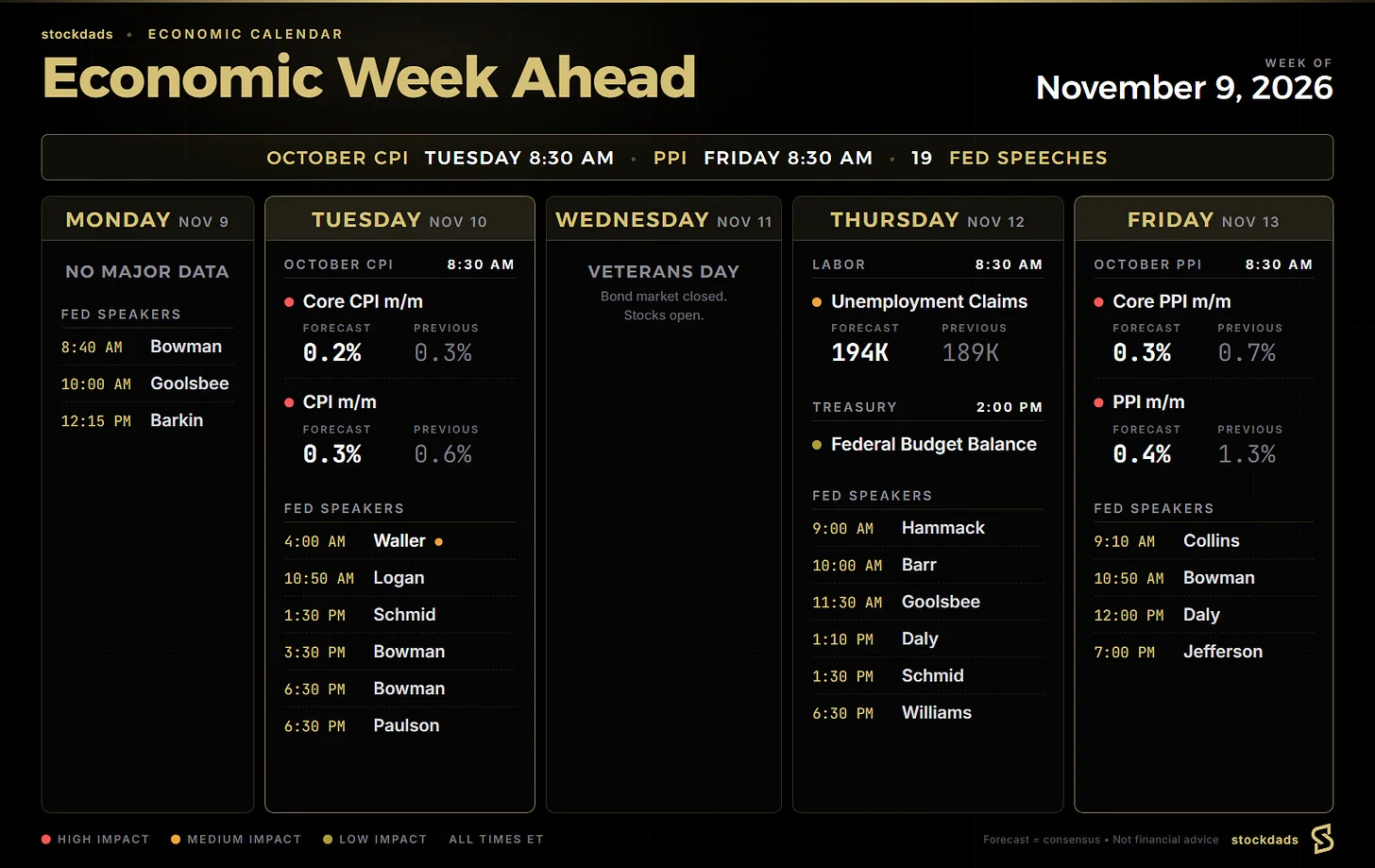
The day to circle is Tuesday. October CPI comes out at 8:30 a.m. ET, with consensus at 0.3% for the headline and 0.2% for core, after 0.6% and 0.3% in September. Gasoline drove September (up 9.1% in a month), and October pump prices averaged about 1% lower (BTS), so the headline should cool. Core is the one the Fed will read. Producer prices follow Friday, with consensus at 0.4% after a 1.3% jump. Nineteen Fed speeches fill the week, including Waller on Tuesday and Williams on Thursday. The bond market is closed Wednesday for Veterans Day, and the next Fed meeting is December 8-9.
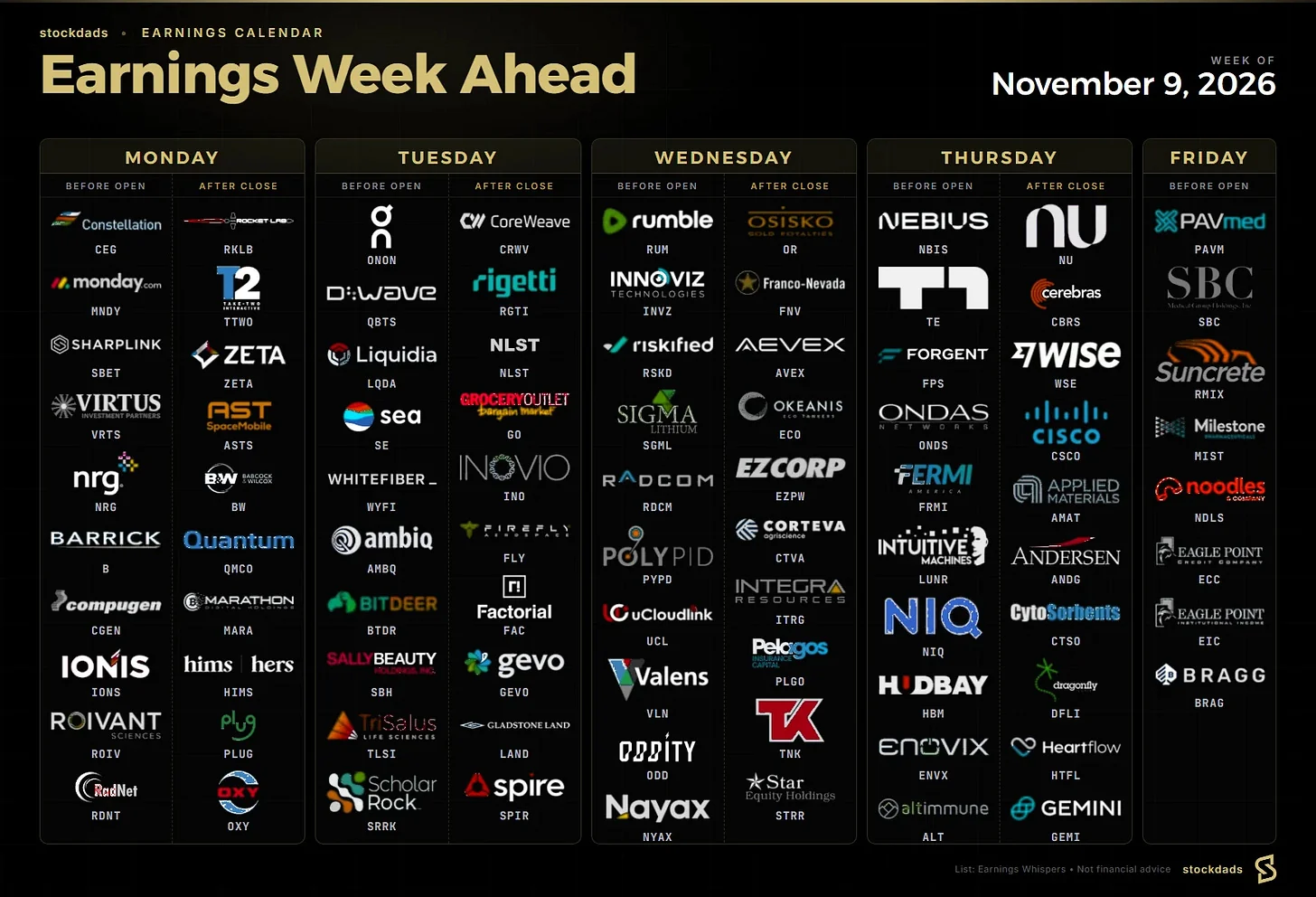
On earnings, CoreWeave reports Tuesday night, and Nebius and Fermi report Thursday morning, so we hear from three of the builders that borrow in one week. Constellation Energy and NRG report Monday morning, NRG with a big Texas business. Cisco and Applied Materials come Thursday night, the first chip equipment read since the selloff. Nvidia reports the following week.
What would change my read:
- Core CPI at 0.4% or more. December becomes a near-certainty, and the productivity argument loses its best data point.
- CoreWeave cutting its capex plan or pushing out revenue. The financing squeeze would be spreading from one neocloud to the largest one.
- The VIX closing below 20 by Friday. It closed at 25.64. A drop below 20 would say the forced selling is done and Thursday was mostly mechanical.
If two of those happen, I’ll say so on Wednesday.
Checking Wednesday’s work
“Democrats won Congress, and history favors stocks from here.” Too early to grade, but the start was rough. The S&P is now down 2.7% from its October 30 close. Wednesday also noted that the average post-midterm window had a 7.1% pullback along the way, and that hiking-cycle years gained about half as much. This one has started with the pullback.
“Oil collapsed, but hike odds went back up.” Held. Brent finished the week at $98.32, and hike odds stayed in the high 70s after the jobs report.
“The bottom of the K is borrowing more.” Held. Affirm and Charter added to it this week.
Three corrections. Wednesday said CAVA “grew on price alone” and people “aren’t going more often.” That was too strong. Traffic was slightly positive, and the CFO said lower-income markets had the strongest same-store sales, from more visits (CAVA call). The scoreboard tagged Coherent “Accelerating,” but its call made clear it’s sold out: “calendar 2027 is basically booked out, and the customers are booking out calendar 2028 now” (Coherent call). And on Qualcomm, the call confirmed that part of the phone drop was lost Apple modem business, with memory the other half (Qualcomm call). Lumentum’s release was also dated November 2, not November 5 as the calendar listed it.
Wednesday’s triggers:
- Hourly earnings at 0.4% or more: yes, 0.4%.
- Brent back above $105: no. It closed at $98.32.
- SMH closing back above 519.50 for two days: no, the opposite. It closed at 447.73 Thursday and 463.96 Friday.
One of three hit, and it’s the Fed one. December is closer to done. The chip trigger went hard the other way, and Section 1 is my explanation for why.
Brian Stock Dads
Published November 8, 2026. Nothing here is investment advice. I'm not a licensed financial advisor and this is market commentary, not a recommendation to buy or sell anything. Jobs data is BLS's October Employment Situation of November 6. Productivity is BLS's preliminary Q3 release of November 5. Jobless claims are for the week ending October 31. CPI history is BLS's September release of October 14; CPI and PPI consensus figures are from Forex Factory's calendar and may differ by source. Michigan sentiment is the preliminary November reading, surveyed through November 2. December hike odds are CME FedWatch as reported by 24/7 Wall St. on November 7; readings vary by source and time of day. Hedge fund figures come from investor letters as reported by Bloomberg, Reuters and the WSJ and are preliminary; Goldman's exposure and leverage figures are via a secondary source citing Bloomberg. Bond prices are from Bloomberg and FINRA TRACE as reported; high-yield trades are thin. Senate, House and governor results are AP calls and not yet certified. Company figures and quotes are from earnings releases, filings and calls. Index, ETF, yield, oil and VIX levels are November 6 closes from Yahoo Finance. Do your own work and size your own risk.
Glossary
Neocloud. A company that builds data centers and rents out AI chips, often with borrowed money. CoreWeave, Nebius and IREN are examples.
Volatility-control funds. Funds that target a set level of price swings. When markets get choppier they sell automatically, usually a day or two later, which can add to a selloff.
Productivity and unit labor costs. Productivity is output per hour worked. Unit labor costs are what a business pays in labor to make one unit. If productivity grows faster than pay, unit labor costs fall, and higher wages don’t have to mean higher prices.
Delinquency rate. The share of loans with a payment late by a set number of days (30 days here). It’s usually the first sign of credit trouble, before losses show up.
Trade alongside our analysts
Join the 1%