Trading psychology
The Caitlin Clark Test: How to Read a Trading Influencer's Income
Zach Austin · · 6 min read
Last updated:
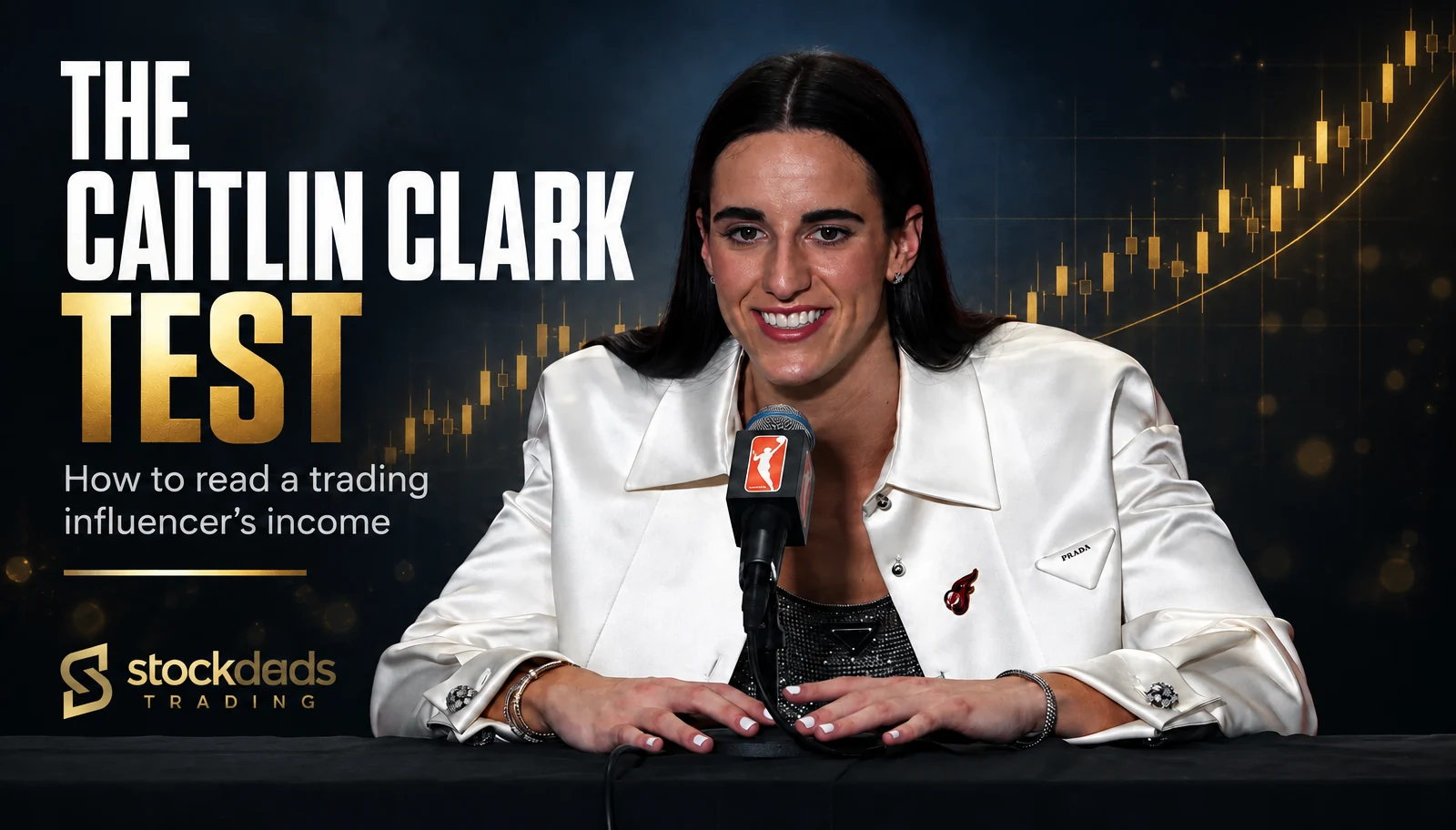
Caitlin Clark's endorsements are a multiple of her WNBA contract. Nobody calls her a bad basketball player for it. Keep that in mind the next time a trader with a Lambo shows up on your feed.
The test
When you see the car, the Rolex, the bottle service, the jet, ask one question: where's the back end?
Most of the guys taking that big leap are doing it because of what they're doing on the business side. The subscription. The Discord. The prop firm deals. Some of them might be solid traders. But a lot of them are making as much, or significantly more, from the business around trading than from the trading itself. My guess is 5, 10, 20x in some cases.
There's no knock on that. I'm all for hustling. There are people in the NBA and the MLB, actors too, who get paid more from endorsements and businesses than from the actual craft. That's the Caitlin Clark test. The off-field money doesn't make her a bad player, and it doesn't make a trader a bad trader either.
What it does mean is simple: you can't read the trading from the lifestyle. The car tells you nothing about the trades, good or bad.
Stock Dads note. The numbers behind the test: in 2025 Caitlin Clark earned about $16.1 million, of which $114,000 was WNBA salary and bonuses and roughly $16 million was endorsements (Sportico). On Forbes' 2026 list of the world's highest-paid athletes, Shohei Ohtani made $2.6 million on the field and $125 million off it; LeBron James $52.8 million on, $85 million off. Across the top 50, $1.1 billion of the $4.1 billion total came from off-field income.
Why Little Jimmy fails the test
The person this is deceiving is the one I call Little Jimmy. Little Jimmy doesn't see the back end. He sees all the flashing things and gravitates toward them like a moth on a light.
So the final boss he's chasing isn't necessarily 100% fueled by trading. Sure, some Little Jimmies along the way will end up very successful, start their own businesses, their own Discords, their own subscriptions. The majority won't.
Check two: the sell test
It's a lot easier to sell a business, a subscription, a service, an indicator, a trading tool, than it is to actually trade, or to teach straight trading.
I have no hate for mentorships. I teach one. But it has to be a good strategy, number one. What bothers me is the gray area: the services, the tools, the enhancements. I'm not even talking about custom indicators or automations. I'm talking about "here's this AI thing that does XYZ," sold for hundreds or thousands of dollars a month.
Here's the test. If this stuff worked, people would be absolutely crushing it. Whoever signed up would be making so much money. Look around. They aren't.
Stock Dads note. The regulators have used almost the same words. In April 2022 the FTC settled with Warrior Trading for $3 million over earnings claims such as "$101,280.47 in under 45 days." The FTC said customers paid "hundreds or thousands of dollars" for the programs, and "most customer accounts actually lost money."
Check three: the top 3
Every strategy out there, ICT (which I don't love), my own, all of them, comes down to the same principles: market structure, price action, candlestick analysis. Those are the top 3. I don't care what anyone says.
Anything else is extra. If it works, it works, and that's great. But people are selling these dreams for hundreds or thousands of dollars a month and taking advantage of retail traders.
What the test can't tell you
None of this tells you whether you'll get the Lambo. So I'll tell you: odds are you're not. I'm probably not getting one either, even if I can afford it.
Stock Dads note. A study of every Brazilian who started day trading mini Ibovespa futures between 2013 and 2015 (Chague, De-Losso and Giovannetti, FGV, 2020) tracked 19,646 people. Of the 1,551 who kept going past 300 days, 97% lost money, and only 8 of them out-earned a bank teller. A separate study of Taiwan's day traders (Barber, Lee, Liu and Odean, 2014) found under 1% were reliably profitable after fees.
The better question
Instead of asking how to get the car, ask what you actually want trading to buy you.
For me it was never the car. Money was the outcome, but the net-net outcome was being in control of my time. Time is the most precious thing we have. Health and time.
Here's what that looks like. A 10 AM flight on a Thursday to a bachelor party for a buddy I played college baseball with, and no boss to ask, "Hey, can I have some time off?" Some of the friends I'm going with had to put in for it weeks ahead and juggle their off days. Being able to pick up and go, get the flight, chip in for the Airbnb, and not think about it.
And the little things. A couple extra pieces of sushi at $10 a pop. The lobster. New shoes when the old ones wear down, new underwear when the old ones rip, without thinking twice. That flexibility, that peace of mind, is the biggest piece for me. Being able to take care of all the little things, that is the true final boss. The one on social media is a facade.
My deal with you
I'd love to look back one day and see that I'm making 10x more from the business than from trading, while still making good money trading. If it ever gets to that point, I'll be real about it. There's nothing wrong with it if you're real about it.
Until then, that's the test. Where's the back end? Would everyone who signed up be crushing it? Does it come down to market structure, price action and candlesticks, or is it all extra?
You're probably not getting the Lambo, and that's okay. It's more than okay, because hopefully you got a hell of a lot more.
Watch the full video on the Zach Austin Trades YouTube channel, and come hang with us in the free Stock Dads Discord: https://discord.gg/stockdads
Sources
Trade alongside our analysts
Join the 1%