Mid-week update
Sooner, not higher
Brian "Fuzz" Farr · · 11 min read

The short and sweet version
The market moved the date, but still looking at higher rates. October hike odds jumped from 17% to 44% after CPI. Traders’ views on where rates end up in 2027 barely moved.
Inflation came in hot, but look inside. Core prices rose 0.3% in September against 0.2% expected. Rent rose at a normal pace, the extra heat came from volatile items like hotel rooms, and the monthly pace was the same as August.
The Fed’s most dovish governor explained why rates stay high. Chris Waller blamed AI spending, government debt, and a vanished “safety premium” on Treasuries worth 50 to 70 basis points.
The Fed’s own survey shows two economies. Rate-sensitive businesses are cutting staff because of higher long-term rates. AI projects are held back by permits and electricians, not by borrowing costs.
The problem: a rate hike hits the half of the economy that’s already hurting and misses the half driving prices up.
1. Sooner, not higher
This morning's inflation report came in hotter than expected (details in the next section). Here's how futures traders repriced the Fed, according to CME FedWatch, compared with Sunday:
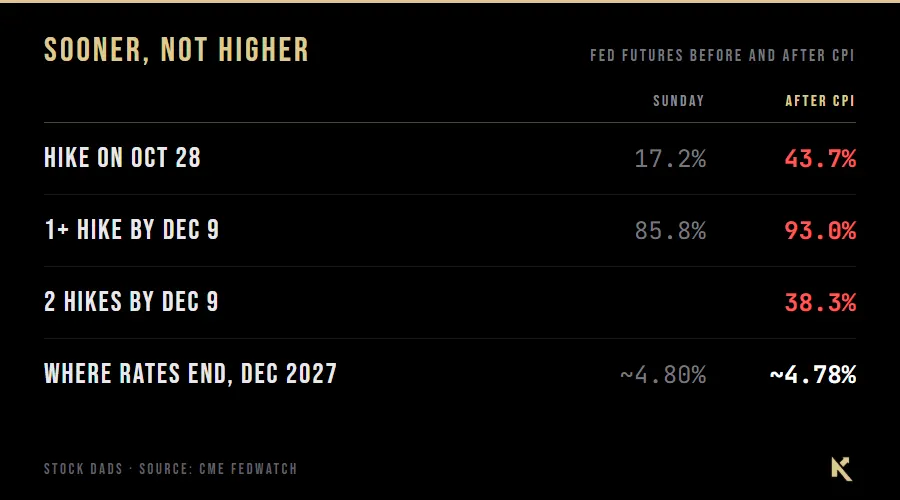
October odds more than doubled. December is close to a sure thing, and more than a third of traders now expect two hikes by then.
Now look at the bottom row. Where traders expect rates to end up in December 2027 didn’t move. Traders didn’t add hikes today. They moved the same hikes earlier. Same destination, just a faster trip. That tells you how the market read CPI. Not “inflation is a bigger problem than we thought.” More like “the Fed will react sooner.”
The caveat: the market isn’t confident about late 2027. The most likely outcome only gets 29% odds. There’s about a 1 in 5 chance rates end at 4.50% or lower, and about a 1 in 4 chance at 5.25% or higher. The near term is a real signal. The far end is closer to a shrug.
2. What CPI actually said
The numbers, from the Bureau of Labor Statistics:
Headline: +0.6% for the month, 3.7% for the year (expected 3.6%)
Core (no food or energy): +0.3% for the month, 2.6% for the year (expected 0.2% and 2.4%)
Core beat expectations. That’s what moved markets. Now look inside it.
Gasoline rose 9.1% and, according to the Bureau of Labor Statistics, accounted for over half of the entire increase. Fuel oil rose 15.3% in one month and is up 74% from a year ago.
Shelter is the biggest piece of core, roughly 44% of it, and rose 0.4%. But:
Rent: +0.2%
Owners’ equivalent rent: +0.3%
Hotel rooms: +2.0%
The two lines that cover where people actually live rose at a normal pace. The jump came from hotels, one of the noisiest numbers in the report.
One more thing: core rose 0.3% in August too. The monthly pace didn’t speed up. The yearly number rose mostly because last September was soft.
The number that matters most: wages. Average hourly pay is up 3.0% from a year ago, per the September jobs report. Prices are up 3.7%. That means real pay is falling about 0.7%. Workers are absorbing the energy shock as a pay cut, not getting raises that push prices higher. That matters a lot. More on it below.
3. The Fed’s dove explains why rates stay high
Chris Waller is the Fed governor most likely to argue for cuts. He spoke at a Bloomberg event in Delhi on Tuesday, the day before CPI. Here’s what he said:
AI spending is pushing up prices. If you’re a big tech company building data centers, he said, “you’ll pay whatever price,” and “you’re going to bid up the price of all semiconductors of all type.” Then:
“We’re starting to see AI having a spreading out of inflation, because it’s just increasing demand for everything else.”
How long? “It could last anywhere from 2 to 3 years.”
AI is pulling money away from everyone else. “The competition from AI is a serious, serious concern... the funds are no longer available for those countries to invest in.”
Treasuries lost their safety premium. This is the big one. For decades, investors accepted lower yields on US government bonds because they were the safest thing to own. Waller:
“That safety liquidity premium on U.S. treasuries is gone. It’s gone... It could be like 50 to 70 basis points.”
A Fed governor is saying the US lost part of the advantage that kept its borrowing cheap. That’s a permanent reason for higher rates, not a temporary one.
The Fed can’t control long-term rates, and he knows who gets hurt. He said the 10-year yield is set by “global supply and demand,” not by the Fed. Asked whether higher yields hurt housing and autos:
“Yeah, of course it is... So it’s not our intent to do it. But that’s going to be one of the natural spillovers.”
Where Waller disagrees with me: he said the AI price effect is narrow, “not like a broad-based effect.” Fair point. Most of what showed up in core this month looks more like fuel costs passing through than chip demand.
He also said inflation expectations “are well anchored.” The New York Fed’s survey has one-year expectations at 3.9%, the highest since May 2023. Michigan’s long-run measure is 3.5%. He may be describing last month’s world.
4. The Beige Book
The Beige Book is the Fed’s survey of businesses in all 12 regions. The newest one came out today, with data through October 5. It reads like a description of a K.
The half that’s hurting:
Cleveland: construction firms are “holding or trimming staffing because higher long-term interest rates had dampened demand.”
New York: a regional bank “reset its loan stress-test assumptions to reflect higher rates.”
Atlanta: “many buyers had difficulty qualifying for a mortgage.”
New York: “rising 401(k) hardship withdrawals” among lower-income workers.
Atlanta: more “buy now, pay later” financing, mostly “for dining out and buying groceries.”
San Francisco: contacts described the economy as “bifurcated or K-shaped,” with pressure spreading to middle-income households.
The half that’s booming:
Kansas City, twice: “the data center buildout has crowded out other production.”
Chicago: tech companies “tried to buy all the available electrical equipment,” and suppliers said no.
Dallas: Texas froze data center permits until it checks the impact on the power grid and water supply.
Multiple regions: data center projects are bidding up pay for electricians and skilled trades.
What’s slowing the AI buildout is permits, electricians and power equipment. None of that changes with interest rates.
And the hawks’ best evidence is in here too. Companies told the Fed that fuel contracts and price hedges are expiring, and new ones cost more. In Philadelphia, contacts expect this to “broaden over the next few months.” Workers are starting to ask for cost-of-living raises. One retailer plans 4% raises, up from 2.5% last year.
That’s how a one-time energy shock turns into lasting inflation. It isn’t in the wage data yet. Businesses say they can see it coming.
5. The banks: the top of the K is doing great
Four big banks have reported this week. Short version:
JPMorgan plans its 2027 interest income around higher rates.
Bank of America assumes three quarter-point hikes by June 2027. That matches the futures market, so it’s planning, not a prediction. Note that BofA earns more when rates rise, about $1.4 billion a year for each full point.
Consumer credit is clean at the top. BofA’s card delinquencies fell year over year for the sixth straight quarter, per its earnings presentation.
Morgan Stanley posted record wealth management revenue and record client assets of $10.5 trillion. Equities trading jumped 41%.
One pair says it all. Morgan Stanley’s wealth clients are borrowing against their stock portfolios: loans grew to $201 billion from $174 billion a year ago. In the same month, the Fed’s New York contacts reported workers pulling money out of their 401(k)s to cover bills.
Same economy, opposite ends.
The cracks are in business lending, not consumer cards. Morgan Stanley took $105 million in charge-offs on corporate and commercial real estate loans. Goldman flagged corporate loan problems last week. BofA said the jump in rates cut client activity in credit, mortgages and municipal bonds.
The other side: none of this looks like stress at the big banks. Loan growth is strong, delinquencies are falling, and capital is plentiful. If trouble is coming, it shows up first at smaller regional banks, which report later this month.
6. Housing: the cleanest K-shape yet
Existing home sales for September came out this week from the National Association of Realtors. Here are sales by price, compared with a year ago:
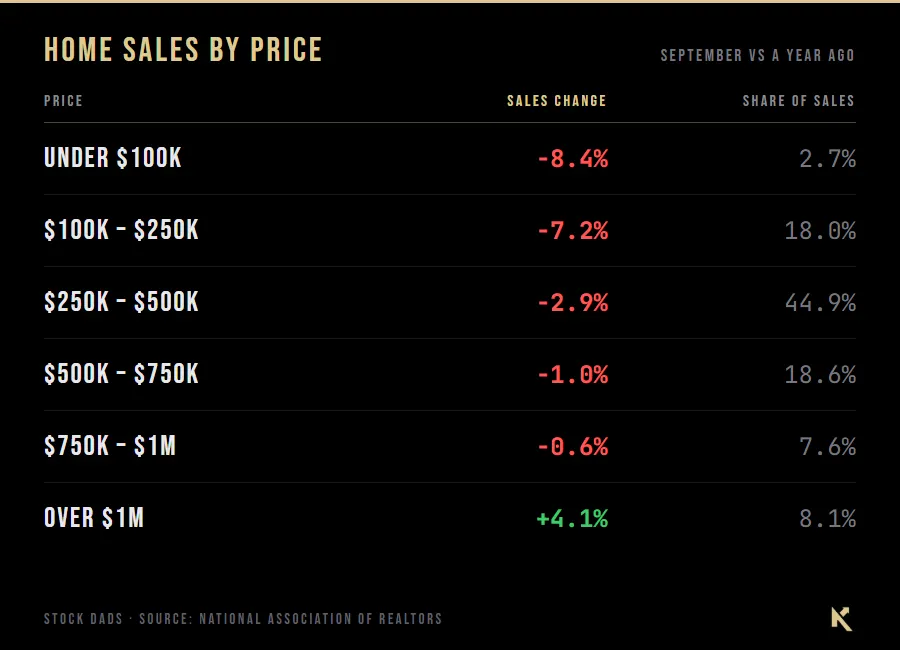
Every step up in price does better than the one below it. The cheapest homes are falling fastest, and only million-dollar homes are growing.
The 30-year mortgage rate averaged 6.86% in September (Freddie Mac), up from 6.35% a year ago. NAR’s chief economist:
“Further increases in mortgage rates in recent weeks mean fewer buyers can qualify to purchase a home.”
That’s the crowding-out story from Sunday, showing up at the closing table.
7. Why a rate hike aims at the wrong half
Let’s put the pieces together.
The tool doesn’t reach the problem.
AI spending doesn’t slow when rates rise. Waller’s own words: they’ll “pay whatever price.”
Fuel prices don’t fall when rates rise. A hike doesn’t make diesel.
What holds back data centers is permits and electricians.
The hike lands on the people already losing.
Entry-level homebuyers, already down 8.4%
Construction firms already cutting staff
Households already drawing down 401(k)s
Workers whose pay already trails prices by 0.7%
A hike doesn’t cool the part of the economy driving prices up. It squeezes the part that’s being crowded out by it.
Here’s the strongest case for hiking anyway, and it’s real:
Expectations are slipping. 3.9% one-year expectations is the highest since 2023. If people expect inflation, they act in ways that create it.
Contracts and hedges are resetting higher, so fuel costs will keep leaking into other prices for months.
Cost-of-living raises are starting. That’s the beginning of a wage-price loop.
Nothing is forcing the Fed the other way. The big banks are healthy and the stock market is near records.
If wages start accelerating, or expectations keep climbing, the hawks are right and a hike is the correct call.
For now, the wage data says it hasn’t happened. And the Fed’s own survey says the hike would hit the wrong half of the K.
8. What’s next
Thursday, 8:30 ET: PPI, retail sales, jobless claims, Philly Fed. PPI is the big one, because it shows whether fuel costs are reaching what businesses charge each other. Retail sales are expected to slow to +0.3% from +1.2%.
Thursday: TSMC earnings, a direct read on AI chip demand. The weekly EIA petroleum report also lands Thursday, a day late because of Monday’s holiday.
Saturday: the Fed’s quiet period starts. After Friday, no more Fed speeches until the October 28 decision.
What would change my mind:
Wages accelerating in the October jobs report. That’s the second-round effect the hawks are worried about.
PPI showing broad price increases outside energy.
One-year inflation expectations above 4%.
If two of those happen, the hike makes sense and I’ll say so.
Checking Sunday’s work
On Sunday I said the CPI consensus was “built to split the difference perfectly” and that both camps would get their number. They didn’t. Core came in at 0.3%, not the 0.2% expected, so the hawks got the headline and the core miss. The doves still have the details: rent, wages, and the hotel-driven shelter number. But they don’t get the clean core print I described.
Sunday’s other tests:
Spreads under 270: no, and moving the wrong way. The high-yield spread (the extra yield on risky corporate bonds) was 303 on Sunday’s data and is 316 now. Still below the October 1 peak of 324.
Breadth above 50%: no, but better. 34% of S&P stocks are above their 50-day average, up from 28% last week.
Distillate building: not yet. This week’s EIA report hasn’t been released, so the latest data is still the week ending October 2. Distillate stocks were flat at 105.1 million barrels, but the on-road diesel grade still drew 0.7 million, and supplies sat 13.5% below last year. Pump prices are newer, and the slide has stalled. Diesel fell 14.7 cents, then 18.3 cents, then just 2 cents this week, to $6.18. That’s still $2.51 a gallon higher than a year ago. No rebuild yet, and the price relief is fading. Thursday’s report is the first one that could show the G7’s emergency barrels.
November 4: still ahead
Brian Stock Dads
Published October 14, 2026. Nothing here is investment advice. I'm not a licensed financial advisor and this is market commentary, not a recommendation to buy or sell anything. CPI is the September release from the Bureau of Labor Statistics. Rate probabilities are from CME FedWatch as of October 14. The high-yield spread is the ICE BofA US High Yield option-adjusted spread through October 13. The Beige Book reflects information collected on or before October 5. Bank figures are from company filings and earnings calls; Bank of America's rate assumption is as described on its call. Waller's remarks are from a Bloomberg event on October 13, taken from the video captions. Home sales data is from the National Association of Realtors. Distillate inventories cover the week ending October 2 and retail diesel is the EIA survey dated October 12; this week's EIA inventory report is delayed to Thursday. Do your own work and size your own risk.
Glossary
Core inflation. Inflation without food and energy, which swing a lot. It’s meant to show the underlying trend.
Real wages. Pay growth minus inflation. If pay rises 3% and prices rise 3.7%, your paycheck buys less.
Safety premium (convenience yield). The discount investors used to accept on US Treasuries because they were the safest, easiest asset in the world to trade. If it’s gone, the US pays more to borrow.
Beige Book. A Fed report, published eight times a year, summarizing what businesses in each of its 12 regions say about the economy.
Trade alongside our analysts
Join the 1%