Macro update
Sold Out
Brian "Fuzz" Farr · · 13 min read
If you missed it, Saturday's Earnings Week Technicals covers the charts, the levels and the options-implied moves for Microsoft, Alphabet and Amazon. This post is the macro side.
The short and sweet version
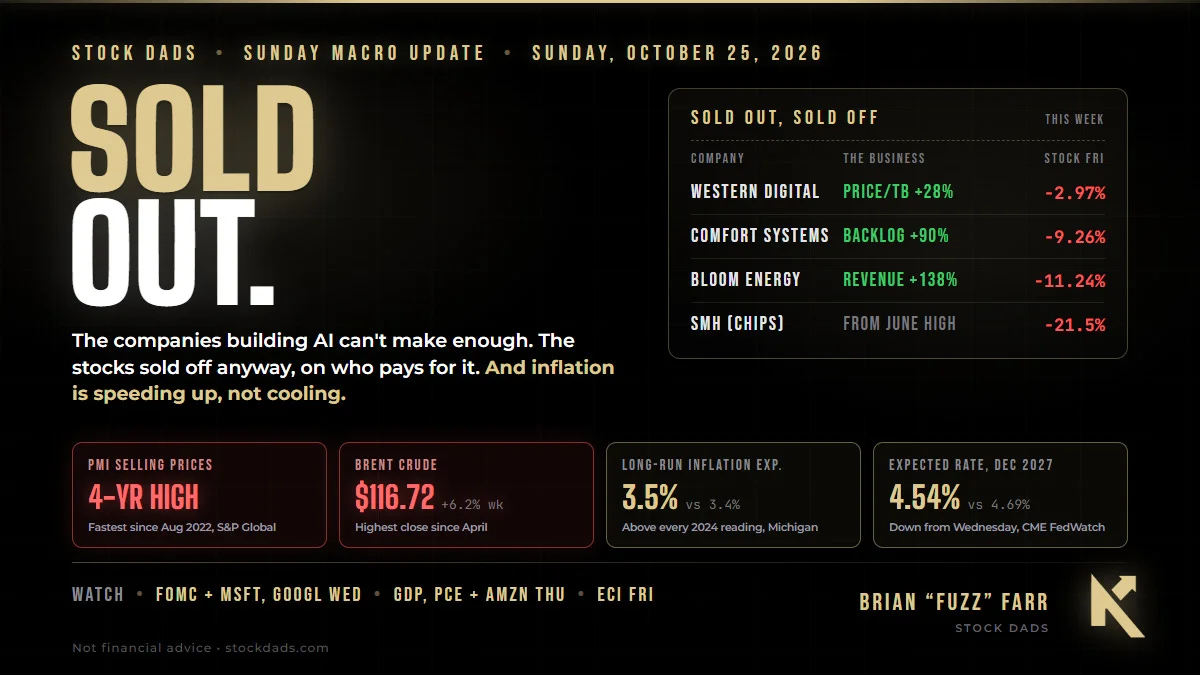
- The companies building AI are sold out. Western Digital raised prices 28% and has demand visibility to 2030. Comfort Systems says the only limit on its growth is finding workers.
- Chip stocks went the other way. SMH is now down more than 20% from its high. Investors are worried about who pays for all of this, and a student lender told us AI bonds are crowding out its loans.
- Inflation is speeding up, not cooling. Business selling prices rose at the fastest pace since 2022, and Brent oil closed at $116.72, up 6.2% on the week.
- The K is complete. AmEx’s affluent customers are spending more on travel. Tractor Supply’s and Deckers’ customers are waiting for sales.
- The market chose the growth scare. The expected late-2027 Fed rate fell to its lowest in two weeks, even as the inflation data got hotter.
1. The AI builders are sold out
Three companies reported the same message last week: they can’t make enough.
- Western Digital raised its price per terabyte of storage 28% from a year ago and expects “further room” for three to four more quarters. Its seven biggest customers have given it demand visibility out to 2030 and 2031. CEO Irving Tan: “We do not see the gap in supply or demand that exists today diminishing in the near term.”
- Comfort Systems, which installs the mechanical and electrical systems in data centers, nearly doubled its backlog to $17.8 billion (release). Technology is now 59% of its revenue. Its president put it plainly: “The governor isn’t demand, the governor is really just labor.”
- Bloom Energy, which sells on-site power, grew revenue 138% and raised guidance for the third time this year. CEO KR Sridhar: “Some individual data centers use more power than some small states.”
Nvidia’s Jensen Huang explained the rush in his GTC Berlin keynote this week. A one-gigawatt AI data center costs about $50 billion and should bring in “tens of billions of dollars per year.” By his math, a three-month delay costs about $10 billion in lost revenue. That’s why customers prepay contractors and build their own power.
Even the oil-services company is in on it. SLB said its data center business grew 23% in one quarter, and it’s building a factory in Canada for Meta.
The pattern: the AI buildout is running into physical limits. Hard drives, power, electricians, clean rooms. And when supply is short, prices go up. That matters for inflation, which we’ll get to.
2. Stocks went the other way
While the companies said “sold out,” the chip stocks broke.
- SMH closed Friday at 527.20, down 21.5% from its June high. That’s bear-market territory. It’s now about 2% above its 200-day average near 515.
- QQQ closed at 704.40, about 7.7% below its October 6 high.
- The S&P 500 fell 0.47% on the week to 7,623.68.
Even the sold-out companies sold off. On Friday, the first trading day after their reports, Bloom fell 11.24%, Comfort Systems fell 9.26% and Western Digital fell 2.97%.
Here’s where the money went last week, from Finviz:
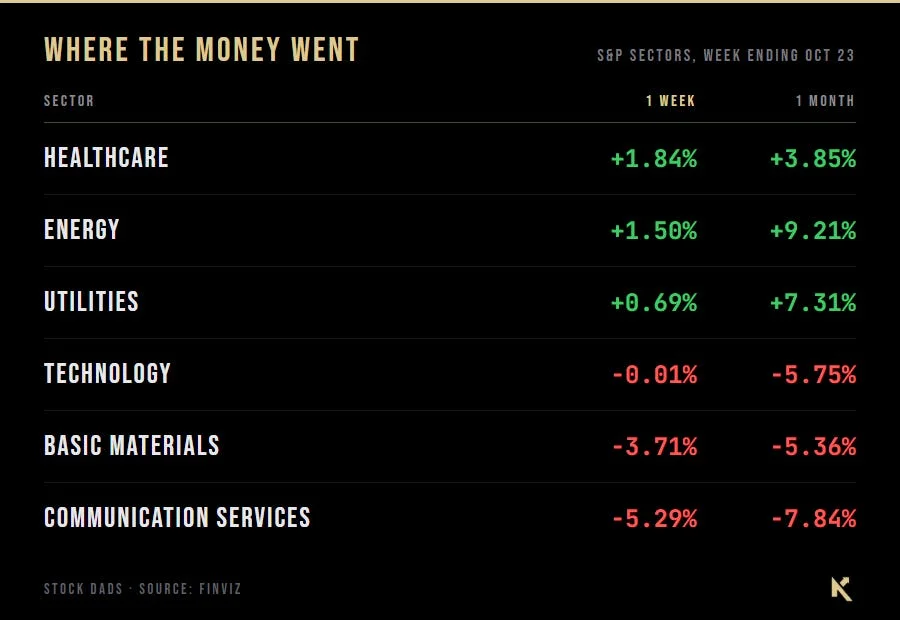
Communication Services is Meta and Alphabet. Technology was flat only because software rose while chips fell.
So why are investors selling good news? The worry is financing, not demand.
- Schwab traces the selloff to an October 8 Financial Times report that OpenAI’s revenue was tracking well below estimates. Since then, the cost of insuring CoreWeave’s debt against default is up 39% in October, and the same insurance on Nvidia, Oracle and Meta has risen too.
- Sallie Mae canceled a planned loan sale because buyers wouldn’t pay enough. Its CFO explained why: “Think about all the ABS that’s funding the AI trades at this point.” Bonds backed by AI assets are pulling investor money away from student loans.
The bear case fits in one comparison. Investor Brad Gerstner has estimated that AI has produced about $200 billion of revenue so far, against roughly $2 trillion needed to justify about $10 trillion of spending over the next decade (as recounted on the Basis Points podcast). The companies say demand is there. The market wants to see the revenue first.
We got a look at both sides of that from one company this week. The Wall Street Journal reviewed Anthropic’s draft IPO filing:
- Revenue: $16.3 billion in the first half of 2026, up from $1.1 billion a year earlier.
- The bill: about $450 billion of cloud computing commitments over the next decade, including $111 billion with Google, $110 billion with Amazon and $31 billion with Microsoft. Including deals still being negotiated, it could spend up to $750 billion.
That’s the AI trade in one company. Revenue is growing about 15 times over, and the commitments are about 28 times this year’s first-half revenue. Somebody has to finance the gap, and that’s the question the market is asking.
Western Digital was asked about the same fear on its call. Management said a slowdown at the newer AI cloud companies wouldn’t be “a major hiccup,” and that it works with the ones that have “a very strong balance sheet.”
The other side. Breadth got better this week, not worse. 53.7% of S&P stocks are above their 50-day average, up from 50.0% Wednesday, and 56.1% are above their 200-day. Money is rotating out of chips into healthcare, energy and software. It isn’t leaving the market.
3. Inflation is speeding up
This week’s data all pointed the same way.
- Business prices. The S&P Global flash PMI showed selling prices rising at the fastest pace since August 2022. Companies blamed “oil-based inputs, energy, fuel and freight rates,” plus steel, aluminum and copper. S&P’s chief economist said the data point to consumer inflation rising “further above the Fed’s target in the coming months.”
- Household expectations. The University of Michigan final survey put one-year inflation expectations at 4.7% and five-to-ten-year expectations at 3.5%, both up for a second month. The 3.5% is above every reading from 2024.
- Oil. Brent settled at $116.72 Friday, up 6.2% on the week and the highest close since April, on expectations of renewed U.S. strikes on Iran (CNBC).
Michigan also published a special report this week, titled “Risks of Entrenchment.” Its argument: like the late 1960s, each supply shock is leaving inflation expectations stuck at a higher floor than the last one. And consumers don’t see tariffs or oil as one-time price jumps. They expect ongoing inflation. The report even raised the possibility that some of today’s strong spending is people buying now to beat future price hikes.
The companies are already passing costs along:
- Valero earned $39.24 per barrel refined, three times last year, and called it “very sustainable.” The bottleneck is refining and shipping, not crude.
- CSX paid 67% more for locomotive fuel, and says truck capacity is tight enough that 2027 freight contracts will “price to the market.”
- Tractor Supply absorbed higher freight costs this year, but says it now needs to “recover some of the higher costs.”
That’s the order the Beige Book described: absorb first, then pass it on.
4. Jobs: no layoffs on the line, some layoffs at the desk
Initial jobless claims fell to 194,000, well below last year’s 231,000. The PMI showed factory hiring at its fastest pace since 2012. Comfort Systems and CSX both said finding workers is their biggest challenge.
But two profitable companies announced white-collar cuts this week. American Express is eliminating about 5% of its jobs worldwide, and Sallie Mae restructured on October 1. The states with the highest share of people on unemployment are New Jersey, Washington, California and Massachusetts.
It’s too early to call that a trend. But it’s worth watching: tight on the job site, looser in the office.
5. The K, from top to bottom
This week filled in the whole picture:
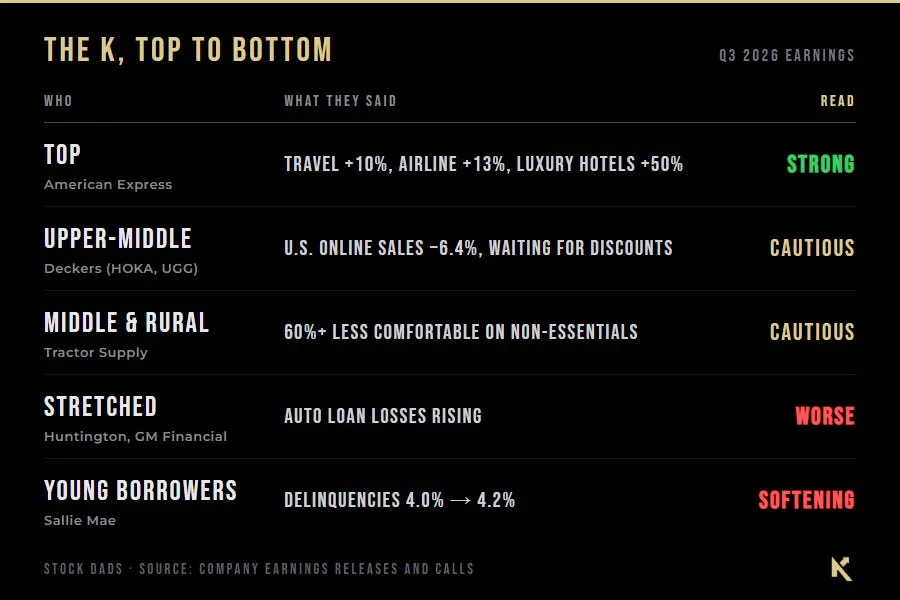
AmEx’s CEO said it best, without meaning to: “We are fortunate to have a premium customer base, which continues to show great strength and stability.”
Two more details stood out. AmEx’s small business spending grew only 3%. And Michigan’s measure of buying conditions for big-ticket items plunged 18% this month, on “higher interest rates and rising concerns about the affordability.”
6. Oil: the fix has started, slowly
There is good news on energy, and it came from SLB, the world’s biggest oilfield services company. High prices are pulling in new supply:
- North American revenue grew 13% from a year ago, excluding an acquisition. U.S. drillers are responding.
- Deepwater project approvals are expected to rise 30% this year, and exploration is getting funded again.
- SLB’s revenue in Venezuela will more than double this year.
The catch is timing. Deepwater oil takes years to arrive. And SLB’s CEO warned that even peace in the Middle East won’t bring quick relief, because “a lot of pull on the strategic reserves and commercial inventory has depleted inventory.” Those barrels have to be replaced first.
Meanwhile, more Gulf oil is getting out than before the war, but much of it goes around the Strait of Hormuz through pipelines. Flows through the strait itself are about 82% of pre-war levels, mostly in Navy-escorted convoys, and tanker rates are about 12 times pre-war (Reuters via BOE Report). The oil is moving. Moving it is the expensive part.
7. What the market did with it
Here’s where traders expect the Fed’s rate to land, from CME FedWatch:
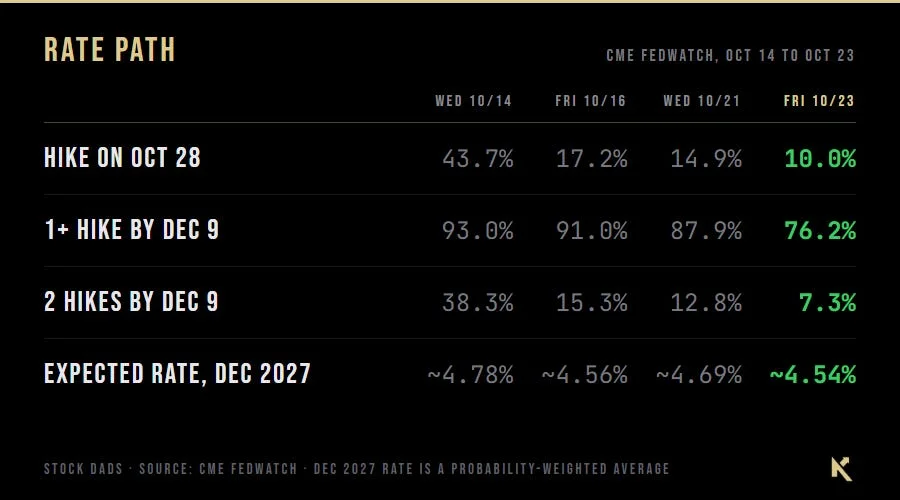
Wednesday’s rebound is gone, and then some. The 10-year Treasury yield fell from 5.09% to 5.00% on the week, including a 17 basis point drop on Thursday alone as chips sold off.
That’s the odd part of this week. The inflation data got hotter, and the expected rate path got lower. Investors decided the bigger risk is the AI trade cracking and taking growth with it, so they bought bonds for safety.
There’s a second reason, and it’s the flip side of the crowding-out story. If AI companies spend and borrow less, there’s less competition for the money that buys Treasuries, so yields fall. That’s why real estate rose 0.96% on a week when chips fell. Rate-sensitive stocks do better when AI borrowing looks likely to slow.
The VIX closed at 19.45, up from the 15s at the start of October, and its trend indicators show volatility building.
8. Two cases
For more hikes:
- Business selling prices are rising at the fastest pace in four years.
- Long-run inflation expectations are at 3.5%, and Michigan is warning about entrenchment.
- Layoffs are low and factories are hiring at the fastest pace since 2012.
- Brent is at $116.72, and suppliers from hard drives to freight are raising prices.
For fewer:
- The AI trade’s financing is under stress: default insurance is rising, and a lender can’t sell its loans.
- White-collar cuts are starting at profitable companies.
- Big-ticket buying, housing and small business spending are weak. Builder confidence is at its lowest since 2012 (Schwab).
- A rate hike doesn’t make oil, electricians or hard drives easier to find.
The market’s answer this week: fewer.
9. What’s next
This is one of the biggest weeks of the year.
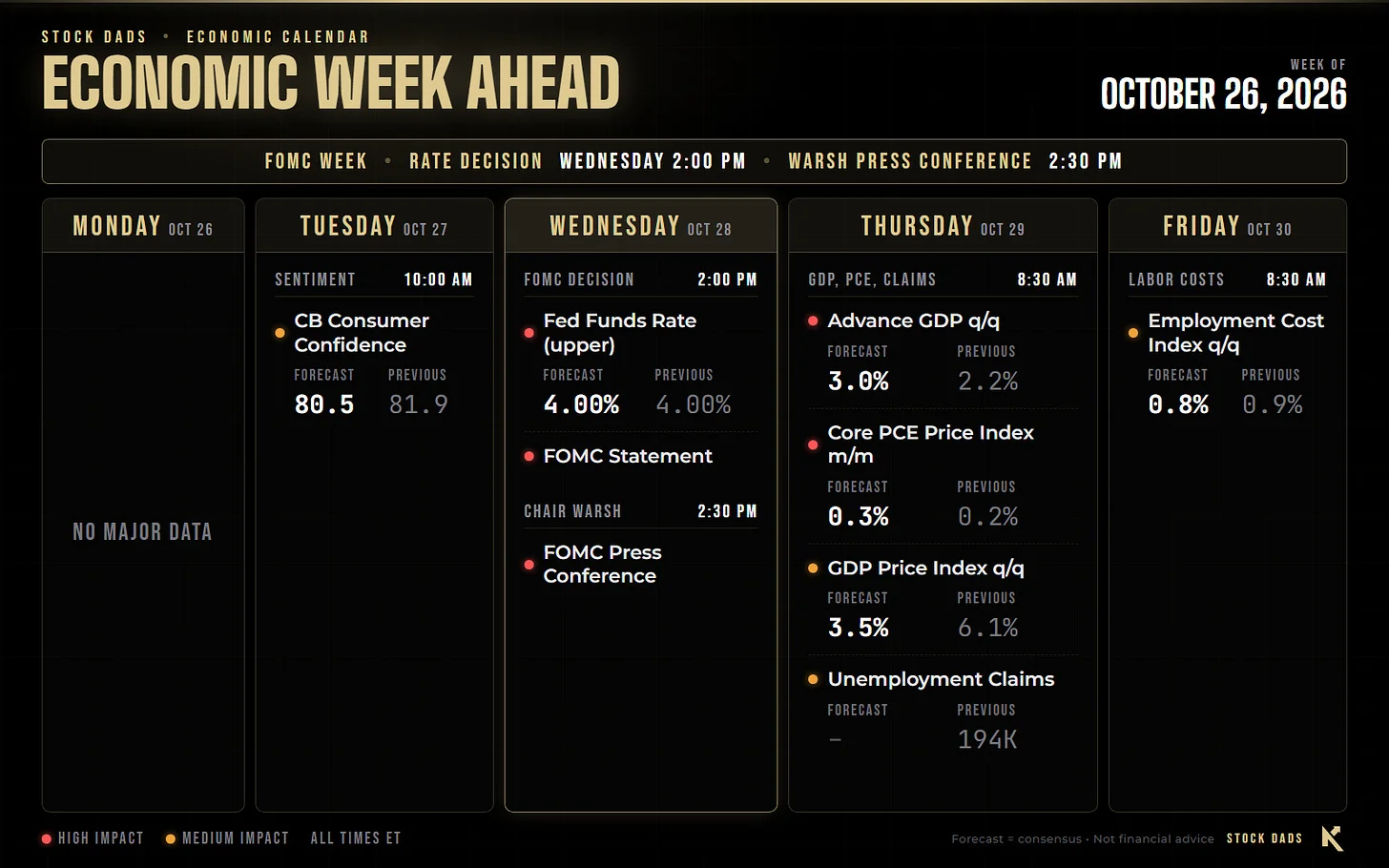
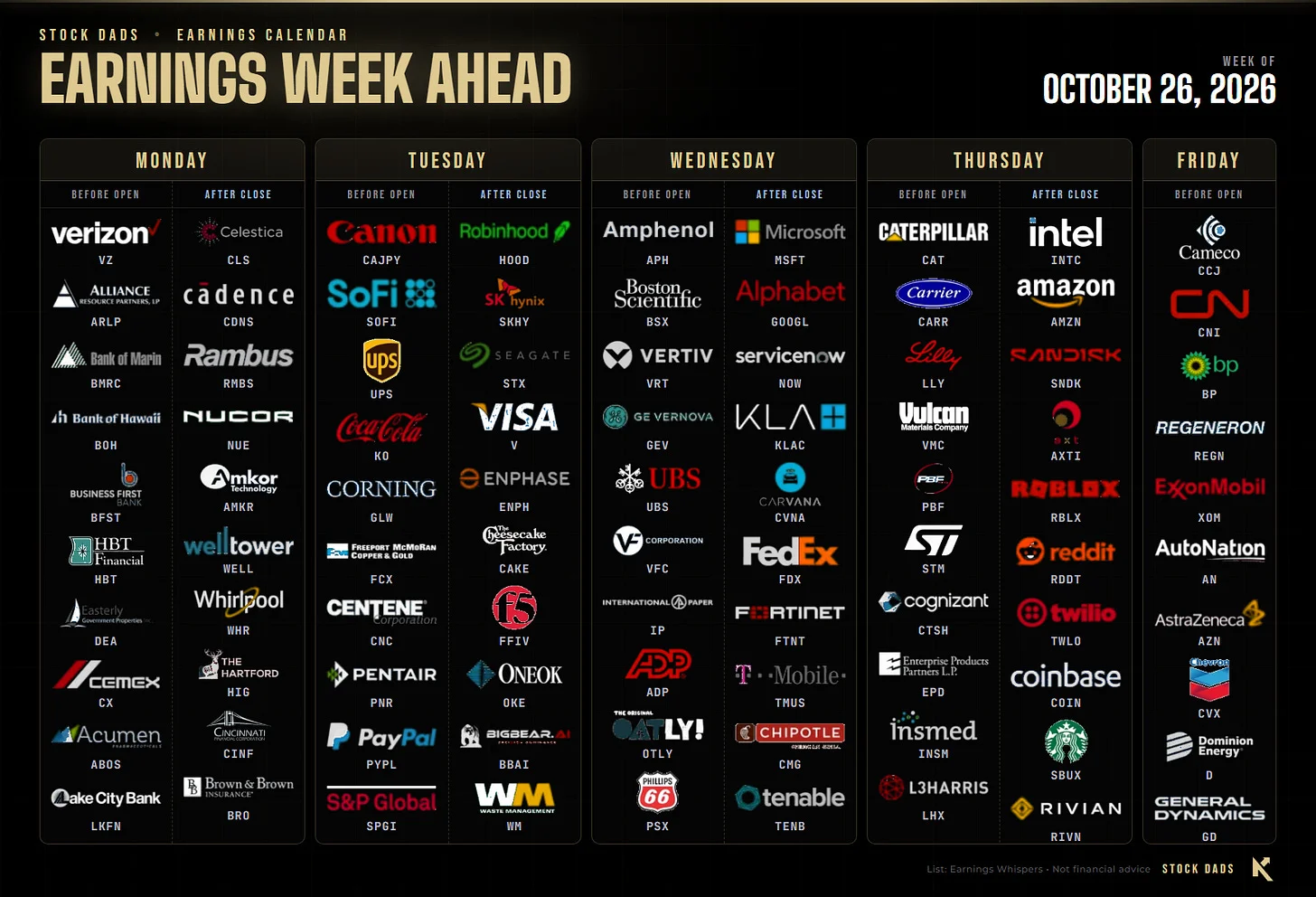
The two days to circle: Wednesday (the Fed, then Microsoft and Alphabet after the close) and Thursday (GDP, PCE and Amazon).
What would change my read (each named to a source):
- Any of Microsoft, Alphabet or Amazon cutting 2027 capex guidance. That would mean “sold out” is peaking, and the chip selloff was early, not wrong.
- Core PCE rising 0.4% or more for September (BEA). The hawks would have the data to back the PMI.
- SMH closing below 515, its 200-day average. The chip selloff becomes a broader breakdown (levels from Saturday’s post).
- The 10-year back above 5.13% while stocks fall. That would mean the rate scare is back, and bonds stop working as a safety trade.
- A second straight distillate build in EIA’s Wednesday report. The fuel squeeze would genuinely be easing.
Checking Wednesday’s work
“AI isn’t slowing down. It’s borrowing.” The spending part held: Western Digital, Comfort Systems and Bloom all say demand is outrunning supply. The financing part got more attention than I expected, and it’s what drove the stocks.
“High prices are cutting usage.” Too confident. I based it on EIA’s 2.4% drop in national distillate demand. Valero, the largest U.S. refiner, said the next day that its distillate sales are up 2% and “you don’t really see any demand response so far.” Both can be true, but the honest version is: national data shows a small dip, and the biggest refiner sees none.
“The far end went back up.” It came right back down. The expected 2027 rate went from 4.69% Wednesday to 4.54% Friday.
“One lender getting worse is a flag, not a trend.” Huntington, a mostly prime lender, reported auto losses up from 0.26% to 0.41% the next day. Auto credit is softening more broadly than I said. Card credit is still fine.
Wednesday’s triggers:
- Michigan’s final one-year expectations above 4.7%: no. It came in at exactly 4.7%, though it rose from September’s 4.6% and the long-run reading rose too.
- SMH back above its 50-day (about 578): no, the opposite. It broke the 539 support Thursday and closed at 527.20.
- A second distillate build: comes Wednesday.
Brian Stock Dads
Published October 25, 2026. Nothing here is investment advice. I'm not a licensed financial advisor and this is market commentary, not a recommendation to buy or sell anything. Rate probabilities are from CME FedWatch as of October 23; the expected December 2027 rate is my probability-weighted average of FedWatch's ranges. Treasury yields are Treasury's daily par yield curve closes. Index, ETF, breadth and VIX levels are as of the October 23 close. Sector performance is from Finviz. Brent is the front-month settlement on October 23. The PMI is S&P Global's October flash release; consumer expectations are the University of Michigan's October final survey. Jobless claims are the Department of Labor release of October 22. Anthropic's figures are from a draft S-1 as reported by the Wall Street Journal and may change in the final filing. The OpenAI revenue figure and credit default swap moves are as reported by the Financial Times and Charles Schwab, not independently verified. Company figures and quotes are from earnings releases and calls. Do your own work and size your own risk.
Glossary
Breadth. The share of stocks in an index above a moving average. Rising breadth while the index falls usually means rotation, not a broad selloff.
Credit default swap. Insurance against a company defaulting on its debt. When the price rises, investors are more worried about getting paid back.
ABS (asset-backed securities). Bonds backed by a pool of loans or assets, like student loans, car loans, or data center equipment.
Inflation expectations. What households expect prices to do. When they rise, people may buy sooner and accept higher prices, which can make inflation harder to bring down.
PCE. The Fed’s preferred inflation measure, from the Bureau of Economic Analysis.
Trade alongside our analysts
Join the 1%