Macro update
Rotation
Brian "Fuzz" Farr · · 12 min read
The short and sweet version
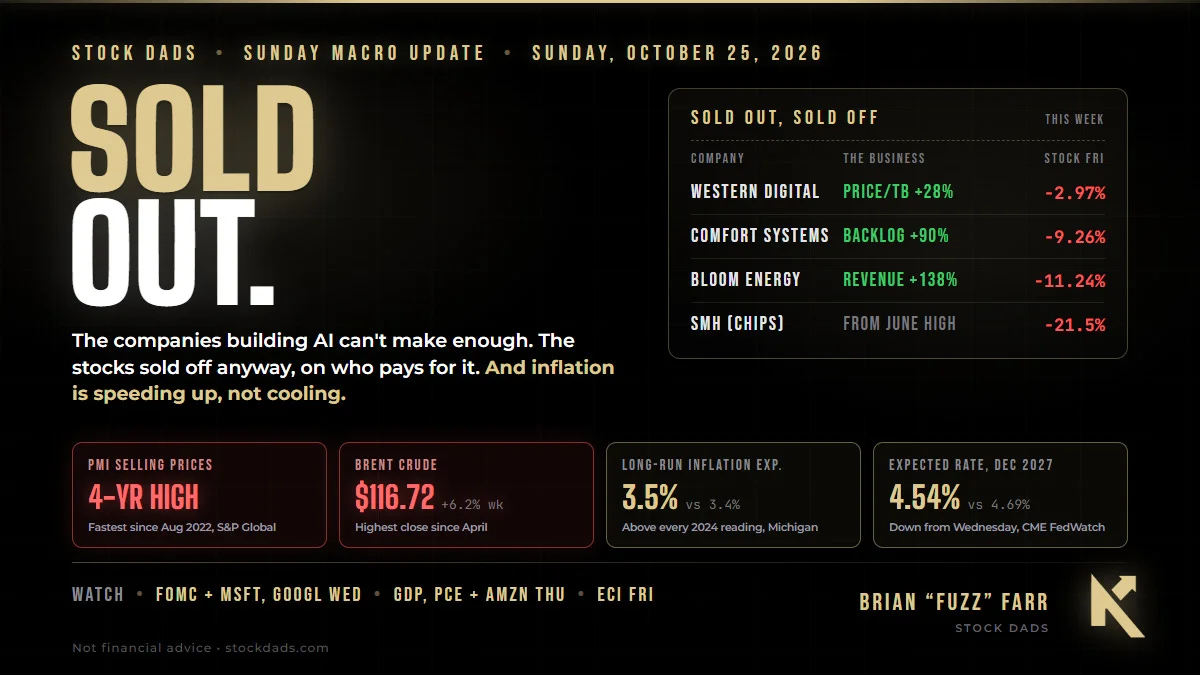
Inflation ran hot, and the market priced fewer rate hikes anyway. Where traders expect rates to sit at the end of 2027 fell from about 4.78% to about 4.56%, roughly one fewer hike. October hike odds are back to 17%. December is still 91%.
Fed Chair Kevin Warsh stopped giving hints. He won’t say in advance what the Fed will do, and he said it isn’t the Fed’s job to protect investors who bet wrong on AI.
The AI trade cracked. The semiconductor ETF fell 15.7% in nine trading days and sits right at the edge of a bear market.
The money moved. Consumer staples rose 5.4% on the week and energy 4.5%, and the share of S&P stocks above their 50-day average jumped to 43.66%.
The inflation pipeline is still full. Producer prices rose 1.3% in September, the most since 2022, and oil is back above $100. That’s why the December rate hike stays on the table.
1. The destination moved (again)
On Wednesday the story was “sooner, not higher.” Hot CPI pulled hikes forward without changing where rates end up. Two days later, that has all changed
Here’s how CME FedWatch moved over the week:
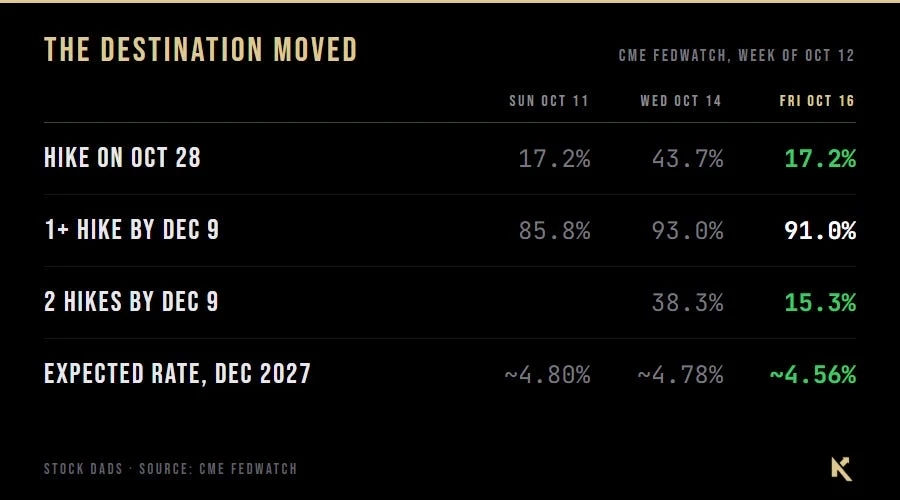
October went right back to where it started. December is still close to a sure thing for one hike, but the odds of two hikes by then fell by more than half.
The bottom row is the most interesting. For the first time in weeks, the expected end point moved, and it moved lower. About 22 basis points, close to one full hike.
The 2-year Treasury yield, which tracks where traders think the Fed is headed, confirms. It closed Friday at 4.74%, down from 4.80% the week before.
One caution on the far end. Contracts more than a year out trade thinly, and the October 2027 meeting actually prices a little higher than September or December. Don’t read that as a hike-then-cut forecast. The clean takeaway is that every 2027 meeting I checked is 15 to 22 basis points lower than on Wednesday.
2. Warsh stopped giving hints
Warsh spoke at the IMF meetings in Bangkok on Friday. October hike odds fell to about 17% while he talked, from roughly 30% that morning, according to Axios. Here’s what he actually said.
On upcoming decisions:
“I don’t prejudge meetings. I don’t believe in saying now what I might do at the meetings that we have in the balance of this year... It’s a new chapter at the Fed, and we’re not in that business anymore.”
For about fifteen years, Fed chairs told markets what was coming. Warsh is saying he won’t. Expect rate odds to swing more sharply on every data point from here, because no guidance is anchoring them.
His words leaned hawkish, even though the market heard relief. He described September’s hike as having “removed a dose of accommodation,” which implies policy was still easy. He said “the world has broadly conformed to our expectations” since then, so the hot inflation data didn’t surprise the Fed. He said central banks worldwide are in a “synchronous tightening,” with “no free riders,” and called it a positive development.
On AI, he lined up with Governor Waller from last week:
“It’s obviously hitting the demand side of the economy before it’s gonna hit the supply side.”
Translation: AI raises inflation now and productivity later. The chair and the committee’s leading dove now agree.
Then the line that matters most for this week:
“What are the consequences for those that bet that they were gonna make money, but the market structure doesn’t allow it?... In my business, we don’t have to figure out who’s right or wrong. That’s what financial markets are for.”
He said the Fed’s job is limited to “negative tail side risks that we can do something about,” and that it has to be “pretty humble” about those. In plain English, there’s no Fed rescue waiting for the AI trade.
3. The AI trade has cracked
The numbers, with the leadership names first:
- Semiconductors (SMH) have fallen 15.7% in nine trading days from October 6. They’re 19.76% below their June 22 high, just shy of the standard 20% bear-market line.
- The Nasdaq 100 (QQQ) is down about 7% from its October 6 all-time high.
- The PHLX semiconductor index fell for eight straight days, according to Schwab.
The catalysts, per Schwab’s weekly review: a Financial Times report that OpenAI’s revenue isn’t tracking expectations, a Chinese memory chipmaker closing in on denser memory designs, Korea’s main stock index falling 14% on the week, and CoreWeave’s five-year credit default swaps hitting a record high. A credit default swap is insurance against a company defaulting. When it gets expensive, lenders are getting nervous.
Notice the timing gap: semiconductors peaked in June, but QQQ kept making new highs until October 6. The leadership was cracking underneath for almost four months before the headline index noticed.
The other side. Demand at the top of the chain hasn’t slowed. TSMC, which makes the chips for nearly everyone in AI, reported Thursday:
- Revenue of $46.7 billion, up 41% from a year ago and above the top of its own guidance
- Next quarter guided to $52.3 to $54.3 billion, up 58% from a year ago at the midpoint
- AI and data center chips are now 68% of revenue
- 2026 capex held at $60 to $64 billion, with 2026 to 2028 spending “significantly higher than the past three years”
On the earnings call, Chairman C.C. Wei said “the demand is higher than the supply” and “we did not see any sign of slowdown.” He said TSMC now sends its own teams to check on US data center construction and power supply, and the feedback is “so far so good.”
Then he said something that fits this whole series:
“We continue to observe consumer and price-sensitive end market segments are being challenged due to the impact of rising component prices and more economic uncertainties. As such, we are being prudent in our business planning going into 2027.”
That’s the K inside the chip industry. AI demand is bidding up component prices, and the cost lands on phones, PCs and consumer gadgets, the price-sensitive end. TSMC’s CFO added that “the tool price inflation is real.” The AI boom is pushing up costs for everyone else in the supply chain, which is the same crowding-out story we’ve been tracking in capital markets.
So this week wasn’t a collapse in AI spending. It was doubt about who earns a return on it, which is almost exactly the question Warsh asked out loud. The giants funding this from cash flow keep spending. The companies funding it with borrowed money, like CoreWeave, are where the stress shows up first.
4. Where the money went
The S&P 500 fell 1.09% on the week to 7,659.44. Underneath, the sectors split hard. Here’s one-week performance from Finviz:
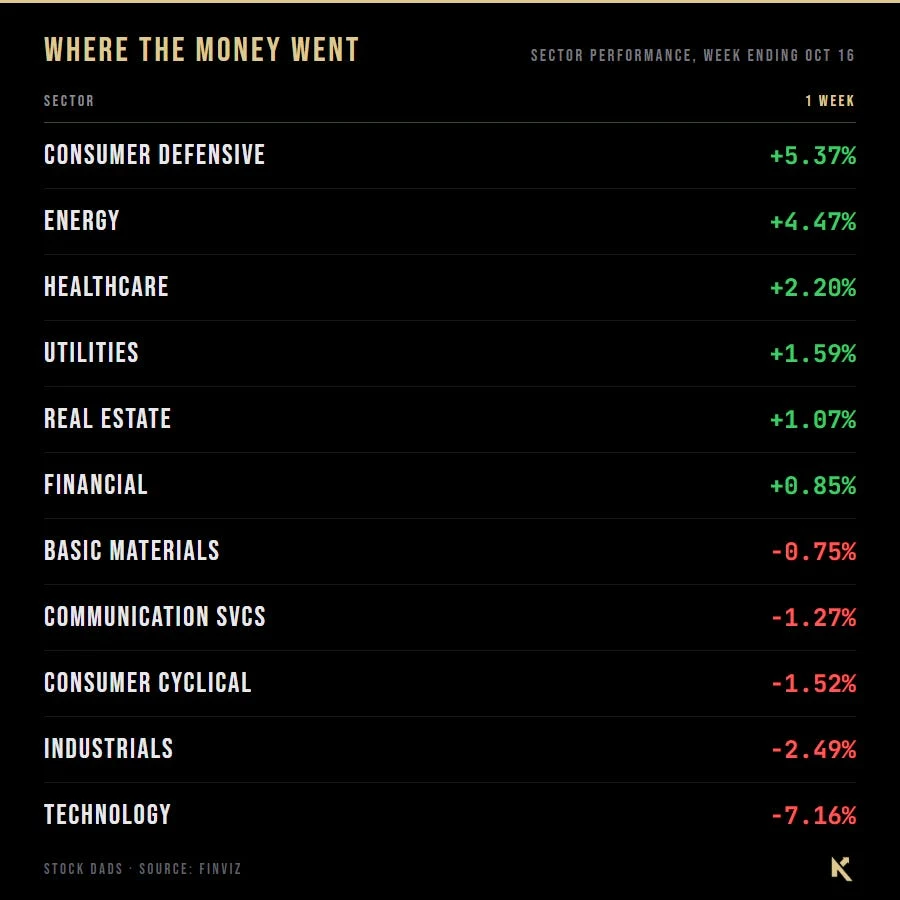
The winners are where investors hide: staples, healthcare, utilities, plus energy as the oil trade. The losers are everything tied to growth: tech, industrials, consumer cyclicals. That explains a puzzle in the breadth numbers. The index fell, but 43.66% of its stocks are now above their 50-day moving average, up from 34% on Wednesday and 28% the week before. 51.91% are above their 200-day.
In September, the index made records while fewer than three in ten stocks participated. This week the index fell while participation rose. That’s an improvement. But it came from defensive sectors catching up, not from the economy-sensitive half of the market recovering. Schwab’s data shows breadth in the Nasdaq and Russell 2000 falling, both near their spring lows, and homebuilders were on the week’s 52-week low list.
Bonds told the same story. Treasury yields fell even though inflation ran hot:
- 2-year: 4.80% to 4.74%
- 10-year: 5.24% to 5.09%
- 30-year: 5.60% to 5.43%
Investors bought Treasuries for safety. That runs counter to Waller’s claim last week that the “safety premium” on Treasuries is gone. This week, at least, people ran to them.
The honest bull case here. Real estate (+1.1%) and financials (+0.9%) rose too, and both benefit from falling yields. If yields keep easing, that’s where a healthier rotation would start.
How I’m handling it. I’m not trying to catch the semiconductor drop. A 15% fall in nine days doesn’t tell you where the bottom is, and a move under the 20% line can bring more selling before it brings buyers. I’m staying patient and carrying more cash than usual. What I want to see before getting interested is SMH holding a level, such as $526 and $511 (daily 200 SMA), for a few sessions and its momentum (MACD) turning up from below zero.
5. Inflation didn’t cool
This is why December is still at 91%.
Producer prices (BLS) rose 1.3% in September against 0.6% expected, the largest monthly gain since March 2022. Prices excluding food and energy rose 0.7% and are up 5.0% from a year ago, according to First Trust.
Look inside and the “ex-energy” heat traces back to fuel in two ways:
- Transportation and warehousing rose 3.4%. That’s fuel surcharges moving through freight.
- Wholesale and retail markups rose 1.4%, and BLS says that explains nearly half the services increase. Machinery and vehicle wholesalers raised margins 3.9%.
That second one is the hawks’ best evidence. When costs jump and businesses widen their markups at the same time, they have pricing power. Markups are also one of the jumpiest parts of the report and often reverse the next month, so one print isn’t a trend.
The pipeline is full. Earlier-stage goods feed consumer prices with a lag. Processed materials are up 14.1% from a year ago, with diesel up 21% in one month. Raw materials are up 21.5%. The Fed’s Beige Book said companies expect this to reach their customers “over the next few months” as fuel contracts and hedges expire.
One timing note: BLS samples prices around mid-month, when diesel was near its high. Diesel has eased since, so some of this is from a price level that has already come down.
Energy is heating up again, though. Oil (WTI) rose about 10% on the week to around $101, on new attacks in the Middle East. Distillate (diesel and heating oil) inventories fell another 2.5 million barrels and sit 12% below their five-year average, according to EIA. The G7’s emergency barrels still haven’t shown up. Pump diesel stalled at $6.18 (EIA), $2.51 higher than a year ago.
And households expect more. The University of Michigan has one-year inflation expectations at 4.7%.
6. The consumer is spending more and buying less
Retail sales rose 0.8% in September against 0.3% expected. That headline is misleading.
- Gas stations rose 6.4% and accounted for about 71% of the entire increase while being 9% of sales.
- Strip out autos and gas and sales rose 0.2%. Census notes that number can’t be statistically distinguished from zero.
- The “control group,” the slice that feeds GDP, rose just 0.1% against 0.3% expected.
- Grocery sales are up 0.9% from a year ago while grocery prices are up 1.8%. People are bringing home less food.
- Gas station sales are up 28% while gas prices are up 34%. They’re buying less fuel too.
Those numbers aren’t adjusted for inflation, so in real terms spending outside the gas tank was roughly flat to down.
The exception is restaurants, up 7% from a year ago, well ahead of restaurant prices. That doesn’t fit a simple “consumer is cracking” story. It fits the K: the Beige Book said spending is “driven by high-income households” in over half the Fed’s districts.
And the job market isn’t breaking. Jobless claims were 199,000 (Labor Department), near historic lows. The Atlanta Fed’s GDPNow estimate for third-quarter growth is 3.64%. Low firing and strong output are the main reasons the Fed feels free to hike.
7. Two cases on rates
The case for more hikes:
- Producer prices posted their biggest jump since 2022, with ex-energy prices up 0.7%.
- The pipeline is up 14% to 21% from a year ago and contracts are repricing.
- Michigan’s one-year expectations are 4.7%.
- Oil is back above $100 and distillate keeps drawing.
- Layoffs are near record lows and GDP is running above 3.5%.
The case for fewer:
- The 2027 end point fell a full hike in two days.
- The AI boom, the main source of demand pushing rates up, wobbled for the first time.
- Long yields fell 15 to 17 basis points despite hot data.
- Real spending outside gas was flat, and households are buying less food and fuel.
- The chair declined to promise anything and said AI losers are the market’s problem.
Put together, the market’s answer is one hike in December, then a lower peak than it expected a week ago. That’s a reasonable read of a week where inflation kept rising and the thing driving it started to crack.
8. What’s next
The Fed is in its quiet period, with no speeches until the October 28 decision.
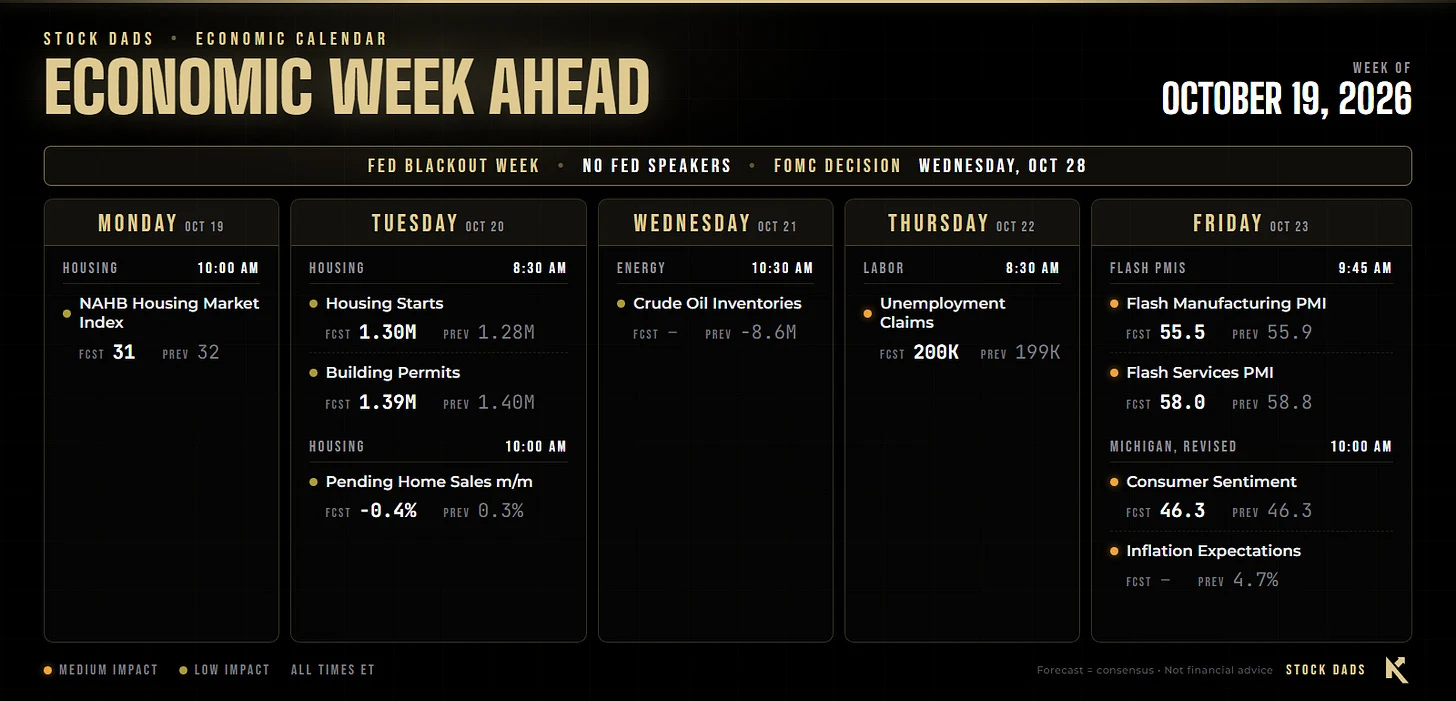
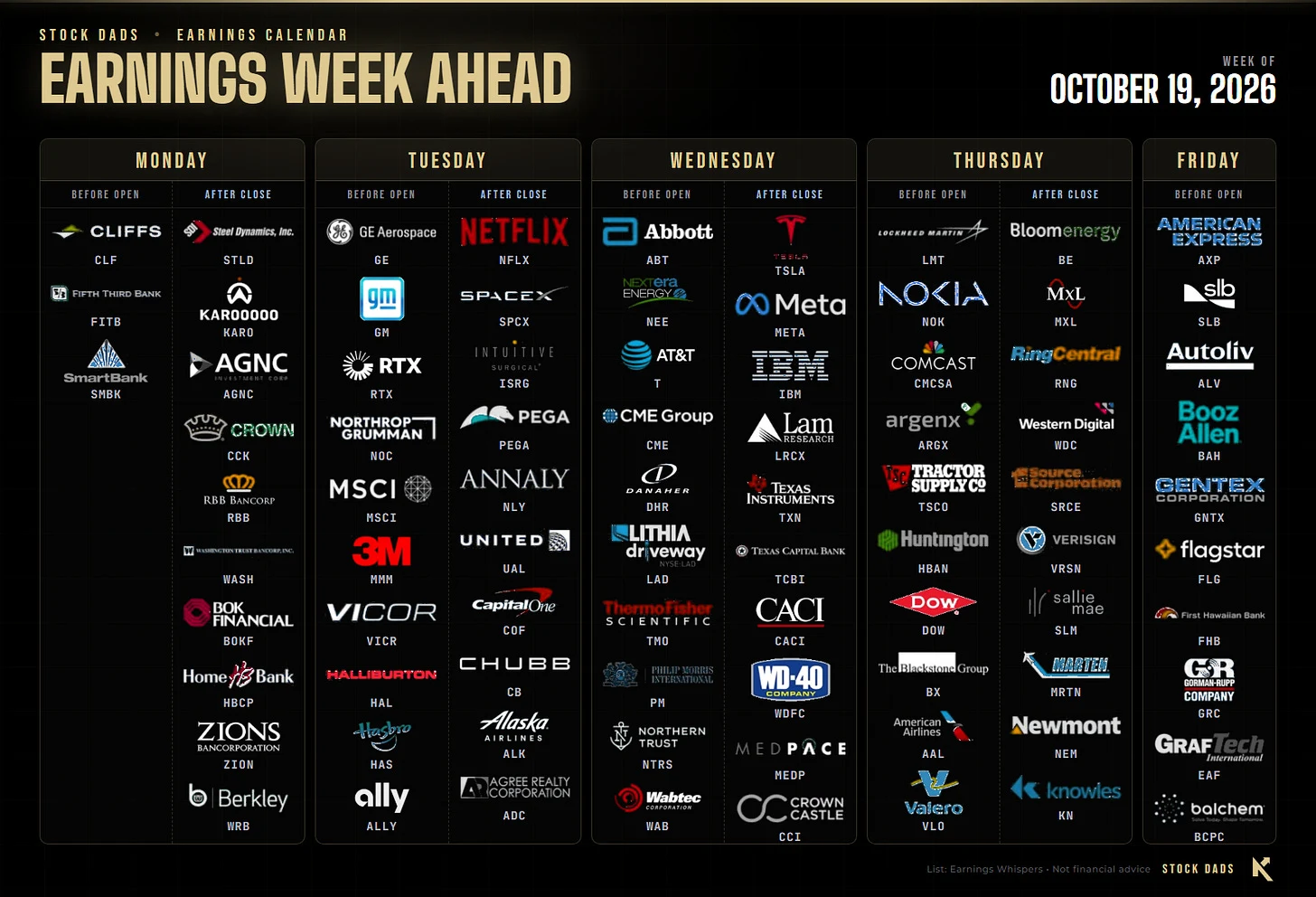
What I’m watching most:
- Capital One and Ally (Tuesday) and the regional banks all week. This is the lower-tier credit test. Big-bank consumer books looked clean last week. If stress exists, it shows up here first.
- Meta (Wednesday). Its capex guidance is the first big-spender read since the AI selloff.
- Valero (Thursday) on refining margins, and United, American and Alaska on jet fuel and fares.
- EIA inventories (Wednesday) for whether distillate finally builds.
- Michigan final sentiment and inflation expectations (Friday).
What would change my read:
- Meta raising its spending plans and SMH reclaiming its 50-day average. That would mean the AI selloff was a shakeout, the demand pressure on rates resumes, and the 2027 end point likely climbs back.
- Michigan’s final one-year expectations above the 4.7% preliminary. That would strengthen the case for more than one hike.
- The high-yield spread above 350. That would mean the AI credit stress is spreading into corporate credit broadly, and the Fed would have a reason to pause even with inflation running hot.
Wednesday’s scorecard items:
- High-yield spread: worse. It hit 325 on October 14, above the October 1 peak of 324, and was 323 on the 15th.
- Breadth above 50%: closer. 28% to 34% to 43.66%, but led by defensive sectors.
- Distillate building: no. It drew another 2.5 million barrels.
- November 4 Treasury refunding: still ahead.
Brian Stock Dads
Published October 18, 2026. Nothing here is investment advice. I'm not a licensed financial advisor and this is market commentary, not a recommendation to buy or sell anything. Rate probabilities are from CME FedWatch as of October 16. Treasury yields are Treasury's daily par yield curve closes for October 9 and October 16. Breadth is as of the October 16 close. Sector performance (Finviz), the S&P 500 close, and the SMH and QQQ moves are through October 16. The high-yield spread is the ICE BofA US High Yield option-adjusted spread through October 15. PPI, retail sales and jobless claims are the releases of October 15. Distillate inventories cover the week ending October 9 and retail diesel is the EIA survey dated October 12, the latest available. Warsh's remarks are from the Bloomberg video of the October 16 IMF interview, taken from captions. TSMC figures are from its October 15 earnings release, and quotes are from the earnings call transcript. The OpenAI, CoreWeave and memory-chip items are as reported in Schwab's October 16 weekly review. Do your own work and size your own risk.
Glossary
Forward guidance. When a central bank tells markets in advance what it plans to do. Warsh says the Fed under him won’t.
Defensive sectors. Consumer staples, healthcare and utilities. People buy groceries, medicine and electricity in any economy, so investors move into these when they’re nervous.
Credit default swap. Insurance against a borrower defaulting. Rising prices mean lenders see more risk.
Producer Price Index (PPI). Prices businesses receive for goods and services. It often shows inflation before it reaches consumer prices.
Control group. Retail sales minus autos, gas, building materials and restaurants. It’s the part that feeds directly into GDP.
Trade alongside our analysts
Join the 1%