Macro update
Crowded out
Brian "Fuzz" Farr · · 14 min read

The short and sweet version
- The era of excess savings has ended. Both St. Louis Fed president Alberto Musalem and JPMorgan’s Jamie Dimon said this separately this week. That period of extra savings kept rates near zero for years without causing inflation. Now, high real rates are the new normal, not just a policy decision.
- Two borrowers are soaking up the capital, and neither cares what the money costs. AI infrastructure at $700 billion to $1 trillion a year, and the federal government at $2 trillion.
- Households and small businesses now compete with AI and the Treasury for the same capital. Asked directly whether that crowds them out, Musalem answered “the answer is yes.”
- The Treasury is already responding. It doubled its buybacks of long-term bonds in August. Citi expects the Treasury to reduce long-term bond issuance on November 4, which could even mean ending the 20-year bond.
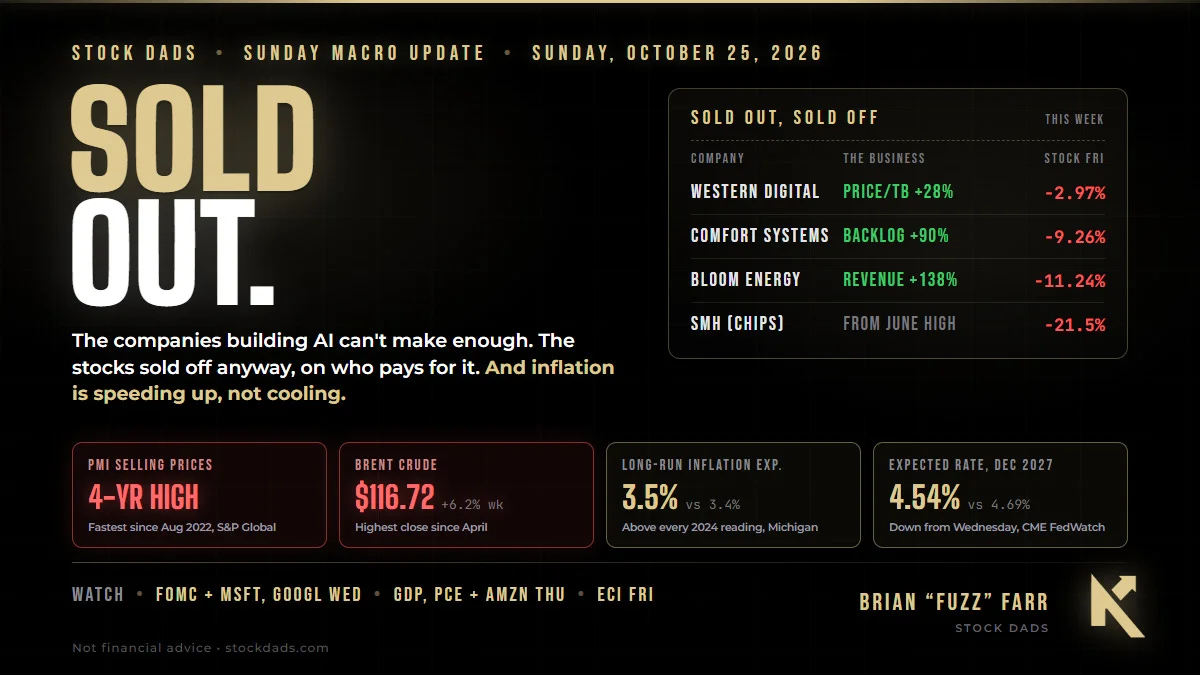
- The bill lands hardest at the bottom. Among Americans who own no stock, 26% say they’ll stop buying things that have become expensive. Their consumer sentiment score is 27.5, compared with 78.6 for the wealthiest stockholders.
The savings glut is over
Two people said this independently in the same week, and neither of them is prone to drama.
Alberto Musalem, St. Louis Fed, Wednesday:
“We’re in a world where there’s a material demand for capital, on the order of 3 to 4% of GDP per year... that’s equal to or larger than our current account deficit. That’s about two-thirds of our fiscal deficit... It’s almost the opposite of the savings glut story.“
Jamie Dimon, Tuesday:
“There’s a supply and demand of capital. If you thought there was a savings glut years ago, now there’s not.“
Two prominent financial figures are declaring the end of the regime that defined the last fifteen years. The savings glut is why rates could sit near zero for a decade without inflation. If it is gone, high real rates aren’t a policy choice; they are a floor. Musalem says the estimates he’s seen run five to ten years.
Where the capital is going
- AI infrastructure.
JPMorgan's research team puts capex at $700 billion this year and potentially $1 trillion next year. Here's a second way to get there. Take what Microsoft, Alphabet, Amazon, Meta, and Oracle each reported spending on property and equipment in their most recent quarter, annualize it, and the five of them together are running at about $780 billion a year.
Musalem on what changed: “Hyperscalers have switched from positive free cash flow a year ago to negative free cash flow now. They’re accessing capital markets in large size.”
- The federal government.
Dimon: “The government’s borrowing $2 trillion again. And this is a global phenomenon.”
Asked directly whether this crowds out everyone else, Musalem said:
“The answer is yes. The non-interest-rate-sensitive issuers are likely going to be putting some financing pressure on the interest-rate-sensitive borrowers. So households, small businesses, even large businesses. There is some competition for capital, for sure.”
That’s the mechanism, from the podium. Two borrowers who will pay any price are bidding against everyone who can’t.
Dimon draws a distinction worth keeping: borrowing to build productive capacity and borrowing to fund consumption aren’t the same pressure. “It could be a good thing if rates are going up because of demand for capital and the capital is viewed productively. The problem part is the government, its consumption.”
The argument I am having about the bond market
I’ve been writing that long yields are rising because the market is charging a term premium, demanding more to lend for thirty years into an inflation it doesn’t believe will be contained.
Musalem says I’m wrong:
“Real yields have been rising almost entirely because the expected real policy rate has been rising, and less so because the real term premium has been rising. Importantly, what is not happening in bond markets is inflation expectations remain anchored.”
His version is that yields are up because the market expects him to hike, not because it doubts him. And he argues expectations stay anchored because the market is pricing a higher real policy rate.
The evidence against him comes from an unlikely place. Treasury runs buyback operations a few times a month, essentially a trade-in counter for its own older bonds. Each has a cap, and how much dealers bring tells you what they are desperate to unload.
- October 6. Treasury offered to buy up to $4 billion of 2-to-3-year paper. Dealers brought $1.3 billion.
- October 8. Treasury offered to buy up to $6 billion of 20-to-30-year paper. Dealers brought the full $6 billion.
Same week. Dealers are dumping every long bond Treasury will take and holding their intermediate paper. The 7-to-10-year operation in June filled 14% of its capacity. Fed rate decisions play out over roughly two to five years. If the move were purely about expected policy, the discomfort would be in the belly of the curve. The belly is exactly where dealers won’t sell. What they can’t offload fast enough is 2056 money.
The Treasury agrees with me and is doing something about it
On August 19, Treasury announced it was raising the cap on long-end buybacks “by at least double,” from $2 billion per operation to at least $4 billion, in the 10-to-20 and 20-to-30 year sectors specifically. Effective September 9. The stated reason was “Treasury’s desire to provide greater liquidity support in longer-dated nominal sectors.” The operations since have run at $6 billion. They said at least double and delivered triple.
Then on Friday, Citigroup’s head of US rates strategy told clients Treasury will likely go further on November 4: cut the 20-year and 30-year auctions by $3 billion each, funded with more Treasury bills. Citi’s tail case is canceling the 20-year bond outright. They’re recommending clients own 20-year bonds against 10-year notes ahead of it.
That’s a forecast, and it runs counter to Treasury’s own August guidance of steady coupon sizes. But Deutsche Bank and Morgan Stanley have flagged long-end cuts as live options too, and the street already has a name for it: the Treasury Twist. Buy the long end, fund yourself at the short end.
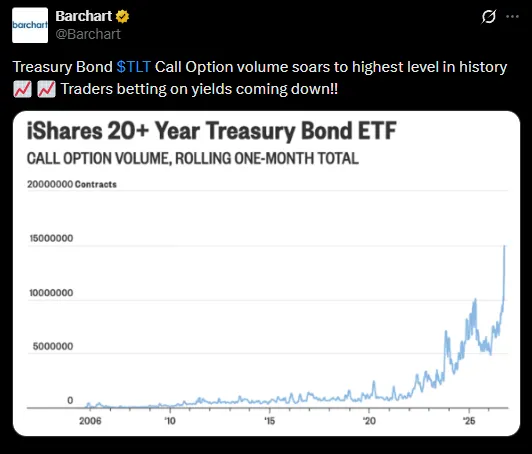
People are trading it. Barchart flagged Saturday that call option volume on TLT, the 20-plus year Treasury ETF, hit a record. Treat that loosely, since one day’s volume can be a single hedge, but the timing behind Citi’s note is hard to ignore.
Treasury is pulling two levers in the same direction, buying more long bonds while preparing to issue fewer. Both reduce the duration the market has to hold.
You don’t do either of those if long yields are rising because the market expects the Fed to hike. Cutting the supply of 30-year bonds does nothing about the funds rate, and nobody pays up for calls on them either. All of it only makes sense if that extra yield is compensation for holding long paper. Treasury’s own behavior is better evidence against Musalem’s reading than anything I’ve argued.
It also explains a question I didn’t understand at the time. Bloomberg asked Musalem about “a new Treasury Fed accord that might align Fed purchases with Treasury issuance,” and he pushed back hard, invoking 1951. Treasury is already running its half. The open question is whether the Fed joins.
Two caveats. BNP Paribas doubts it would actually lower borrowing costs. And funding long deficits with short bills is a bet that short rates come down. If they don’t, you refinance at high rates over and over.
November 4 determines everything: the auction and buyback sizes, and whether the current $6 billion operations continue. They expire that day.
The consumer is where this lands
Michigan sentiment printed 46.3 on Friday, down from 48.1 and a new low for the cycle. Current conditions fell 6.2 points in one month. Long-run inflation expectations rose to 3.5%. Hsu’s team also published a special report built on 3,492 interviews. It’s the clearest picture of this economy I’ve seen. Sixty-nine percent of consumers say they’ll cut back or stop buying items with large price increases. Only 31% will spend as usual.
Now split that by stock ownership:
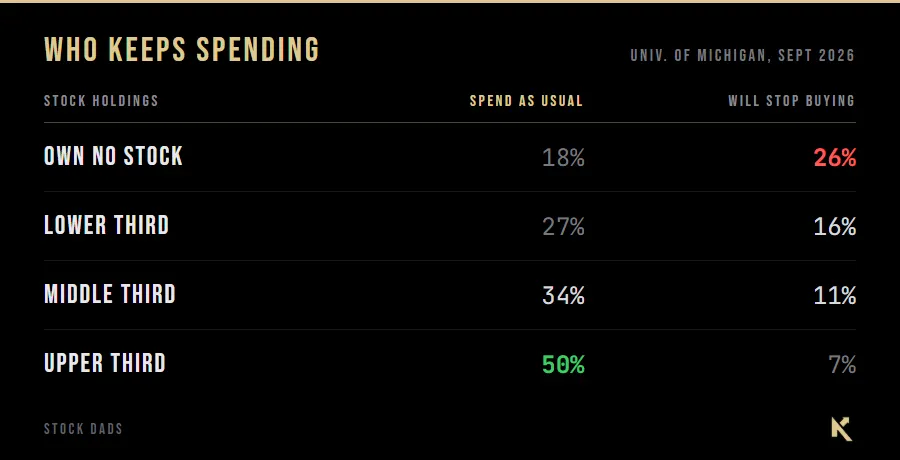
Half of the wealthiest stockholders will carry on as normal. Fewer than a fifth of non-stockholders will. And the gap is widening. Hsu: “About half of the wealthiest stockholders expect to spend as usual, up substantially from 39% in 2025.” The top got more confident while the bottom cut.
Sentiment inside those groups is the part I can’t get past:
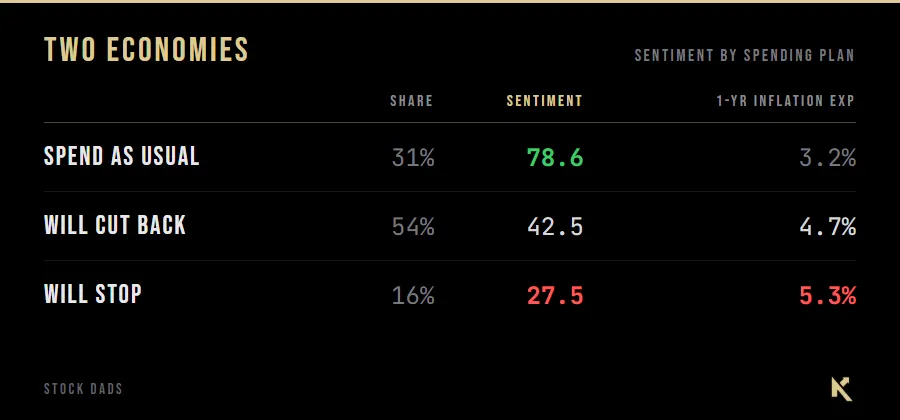
A 51-point sentiment gap. The top group sits at roughly the long-run average. The bottom group is at 27.5, far below any aggregate reading ever recorded, with 71% of them expecting unemployment to rise. Hsu calls their outlook “largely stagflationary.”
Musalem described the same thing from his district: people “resorting to buy now, pay later, more not to buy the luxury vacation to Hawaii, but to buy food,” rising HELOC usage, charities fielding more calls about utility bills. And at the top, “wealth effects... keeping consumption growing very strongly.”
Then he said the thing the Fed actually believes:
“Our mandate is an aggregate mandate, not a distributional mandate.“
They see it clearly. They’ve decided it isn’t their job. That’s a defensible reading of the Federal Reserve Act, and it’s also the whole argument.
Where the hawks won and lost this week
Won. The September minutes showed many participants already worried that the longer energy prices stayed elevated, the greater the risk of “broader price pressures.” ISM prices hit 77.9 in manufacturing and 74.0 in services, with the services chair reporting that fuel costs were cited twice as often as any other issue. The New York Fed put one-year inflation expectations at 3.9%, highest since May 2023. Michigan’s long-run measure rose to 3.5%. And Musalem, the committee’s most hawkish voice, now says rates should rise further over the next six to nine months.
Lost. Diesel fell 33 cents in two weeks, and distillate inventories stopped drawing. Credit spreads peaked at 324 on October 1 and are back to 303. The committee’s claim that the labor market had “strengthened” was contradicted days later by a 29,000 payroll print against a 485,000 increase in the labor force. And wages at 3.0%, with a three-month annualized rate of 2.36%, aren’t generating anything.
The scorecard: they were wrong about labor and credit, and right about energy broadening into other prices. The second one is what’s left.
Wednesday decides
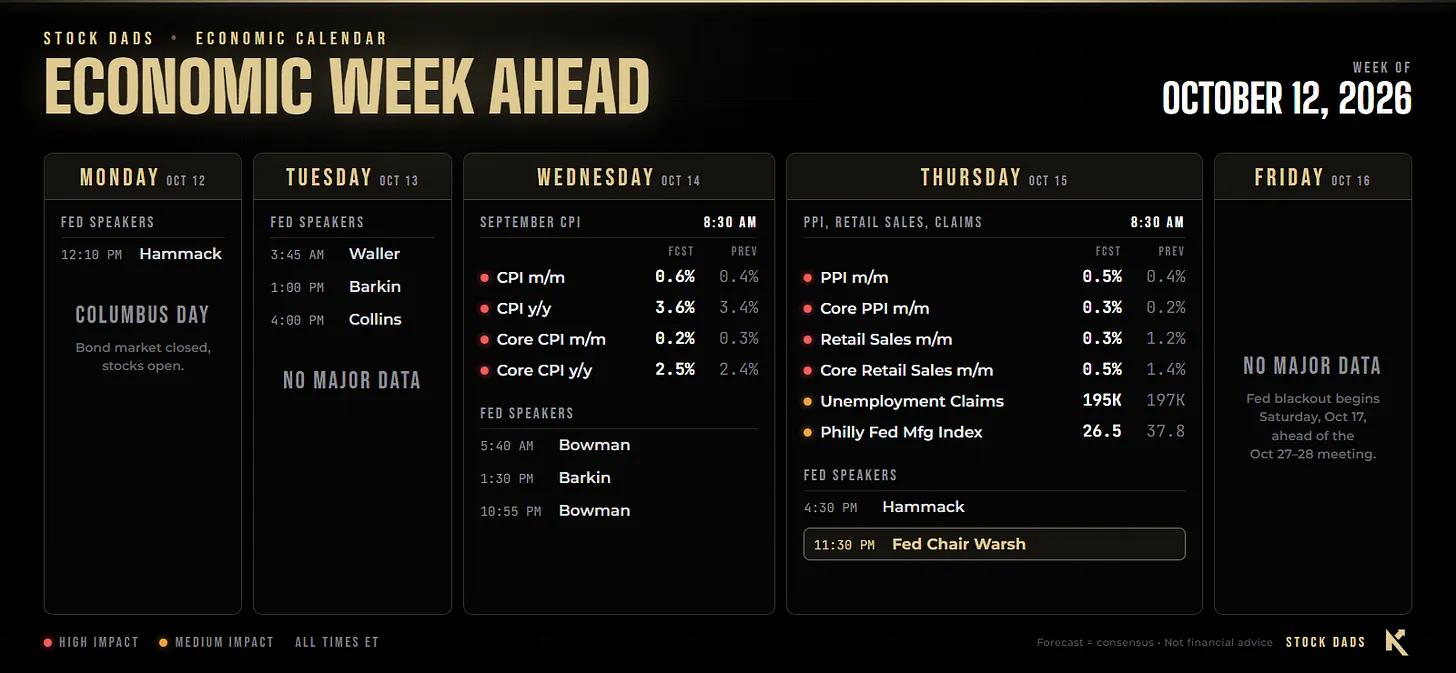
September CPI lands Wednesday at 8:30, and the consensus is built to split the difference perfectly.
Headline: +0.6% month over month, 3.6% year over year, up from 3.4%. Core: +0.2% month over month, around 2.4%. If that prints, the gap between headline and core widens to 120 basis points, all of it energy. Both camps get their number from the same release.
The rest of the week: PPI, retail sales, claims and Philly Fed all at 8:30 Thursday, with retail sales expected to slow hard to +0.3% from +1.2%. Bank earnings start Tuesday with JPMorgan, Goldman, Wells Fargo and Citigroup, then Bank of America and Morgan Stanley Wednesday. TSMC reports Thursday. Monday is Columbus Day, bond market closed, stocks open.
The banks matter more than usual. Dimon already said the quiet part: “there will be a point where the market will ask for more and more and more. And at one point, they’ll feed into corporate debt, corporate credit spreads, and things like that, which is how it normally happens.” Tuesday he has to say what his own credit book looks like.
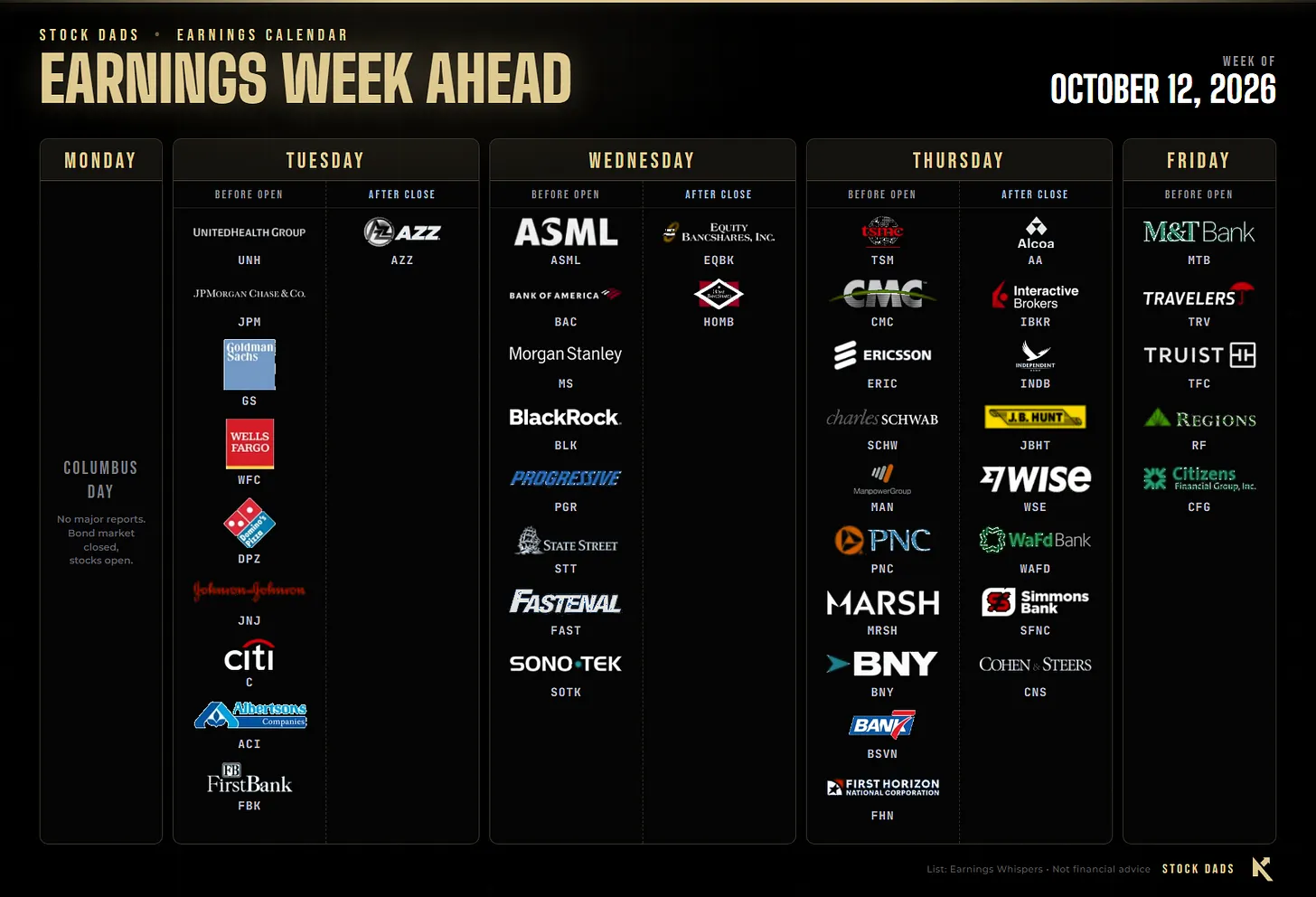
And next week is the last week Fed officials can speak. The quiet period before the October 27-28 meeting begins Saturday the 17th.
What could prove me wrong
- November 4. If Treasury holds coupon sizes steady and lets the enlarged buybacks lapse, the Twist thesis dies.
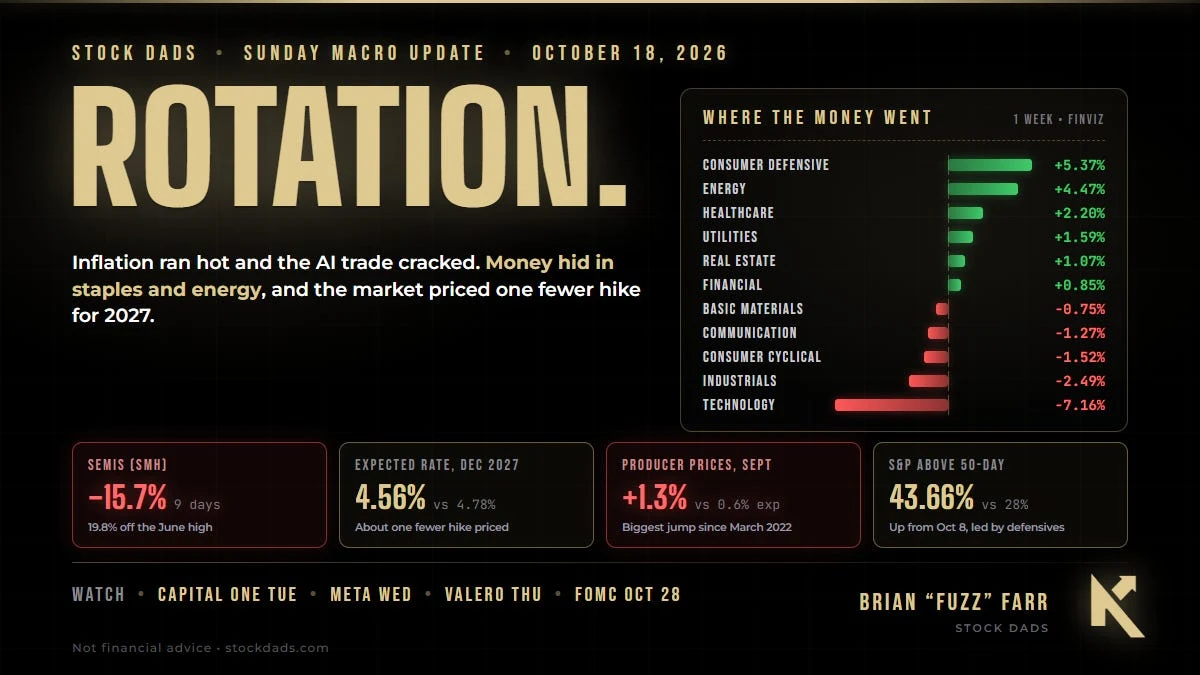
- Breadth above 50%. It’s at 28.11% after the index made a record Tuesday. If participation catches up, the September collapse was a washout and I was early.And a caveat on that one. Adam Grimes has tested this across 35 years and found weak breadth at 52-week highs does not predict declines. For percent above the 50-day, a 10% drawdown followed weak readings 6.1% of the time versus 9.1% after strong ones. He’s candid that the samples are tiny and mostly not significant. Still, it’s worth separating two claims: breadth tells you where the tightening is landing, which is how I’m using it here, and breadth forecasts a top, which his data says it doesn’t.
- Spreads under 270. Same conclusion from the credit side. They’re at 303 and falling.
- Distillate building Wednesday. If the G7 barrels show up in inventories, the fuel pass-through fades and the hawks lose their best evidence.
Two of those and the December hike probably doesn’t happen.
The argument
The last fifteen years ran on a surplus of savings chasing too few places to put it. That is over, and the two people best positioned to know said so within two days of each other. What replaces it is two borrowers who don’t care about price. AI infrastructure is spending three quarters of a trillion dollars a year and has gone cash-flow negative to do it. The federal government is borrowing two trillion. Between them they’re absorbing capital equal to two thirds of the fiscal deficit, every year, for as long as anyone’s estimates run. Everyone else bids against them. That’s households, small businesses, and the rate-sensitive half of the stock market, which is why 28% of the S&P sits above its 50-day while the index prints records. And at the end of the line is the fifth of the country that owns no stock, where 26% say they’ll stop buying things outright and sentiment reads 27.5.
The Fed sees all of it. Musalem described the buy-now-pay-later groceries himself, in the same interview where he called for six to nine more months of tightening. He isn’t being callous. He’s telling you the mandate is aggregate, the aggregate looks fine, and the distribution is somebody else’s problem.
He’s right about the mandate. That’s what should worry you.
Corrections from last Sunday
I wrote that the market expected roughly three rate cuts by September 2027. That’s backwards. Futures price a 17.2% chance of a hike on October 28, 85.8% odds of at least one by December 9, and an expected fed funds midpoint near 4.80% by December 2027. That’s about four more hikes, not three cuts.
The 2-year is at 4.79%, sitting almost exactly on the market’s own expected terminal rate. I took a line from a weekly summary and never tested it against the curve.
I also cited JPMorgan marking September’s consumer sentiment of 48.1 as a cycle trough, with an average 24% twelve-month return from nine prior troughs. October printed 46.3. It wasn’t a trough, and that was the strongest item in my bull case.
Brian Stock Dads
Published October 11, 2026. Nothing here is investment advice. I'm not a licensed financial advisor and this is market commentary, not a recommendation to buy or sell anything. Breadth is as of the October 8 close. Credit spreads and Treasury yields run through October 6. Retail diesel is the EIA survey dated October 5 and inventory data covers the week ending October 2. Consumer sentiment is the October preliminary and rate probabilities are from CME FedWatch. Next week's forecasts are consensus estimates and will change. The November auction sizing is Citigroup's published forecast, not a Treasury announcement; Treasury's own August guidance pointed to steady coupon sizes. Do your own work and size your own risk.
Trade alongside our analysts
Join the 1%